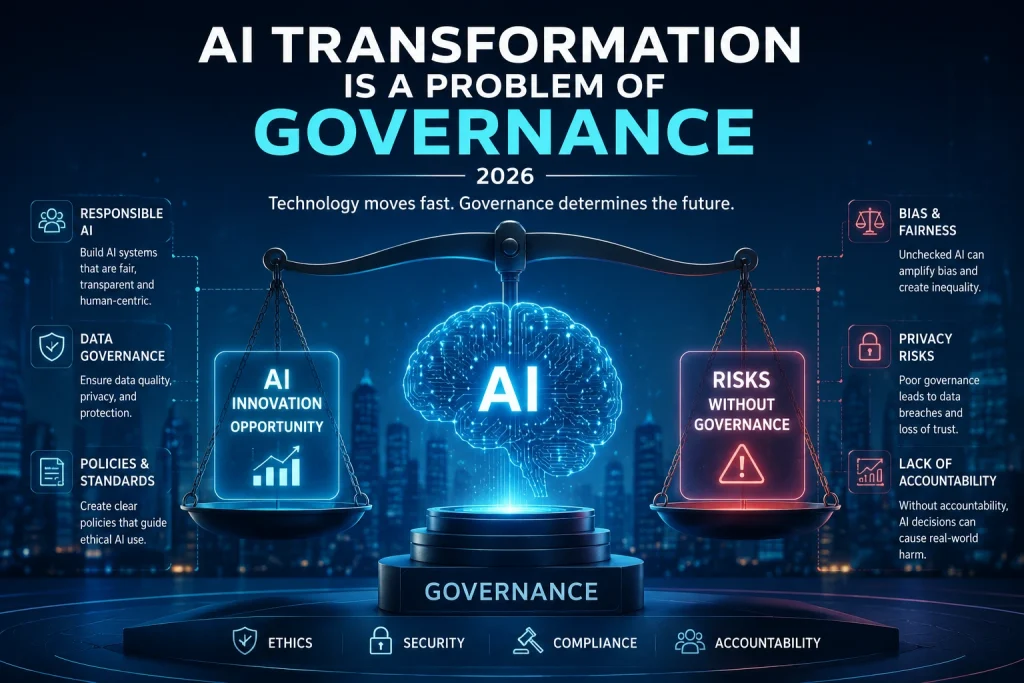
Is Ai Transformation a problem of governance 2026 ? Most companies did not fail at AI because their models were weak. They failed because nobody could answer a simple question: who is accountable when the system gets it wrong?
That question is the entire story of enterprise AI in 2026. Budgets are no longer the bottleneck. Talent is no longer the bottleneck. The bottleneck is governance , the structures, roles, and controls that decide whether an AI system can be trusted to act.
This guide breaks down what enterprise AI governance actually means, why it has become the single biggest driver of AI ROI, and exactly how to build a framework that works , with a maturity model, a step,by,step roadmap, real 2026 data, and mistakes to avoid along the way.
Table of Contents
- What Enterprise AI Governance Actually Means
- The 2026 Data: Why Governance Is Now the Deciding Factor
- Governance vs. Risk Management vs. IT Controls
- Who Should Own AI Decisions? Building Real Decision Rights
- Why Agentic AI Broke the Old Governance Playbook
- The Six Governance Gaps That Kill AI Programs
- The Seven Pillars of a Working AI Governance Framework
- The AI Governance Maturity Model
- A 90,Day Roadmap to Operational AI Governance
- Governance by Industry: What Changes and What Doesn’t
- Pros and Cons of Formal AI Governance
- Common Mistakes Enterprises Make
- Best Practices From Companies Doing This Well
- Future Trends: Where AI Governance Is Headed
- Frequently Asked Questions
- Expert Verdict
- Final Conclusion
AI Transformation Is a Problem of Governance
Many organizations assume that AI transformation is primarily a technology initiative, but the reality is very different. While advanced AI models and automation platforms are becoming easier to adopt, the biggest challenge lies in governing how AI is selected, deployed, monitored, and managed across the business. Without clear governance, companies face inconsistent decision-making, security vulnerabilities, regulatory risks, data quality issues, and uncontrolled AI spending. Sustainable AI transformation requires policies, accountability, risk management, and executive oversight that align AI initiatives with business objectives. In 2026, organizations that establish strong AI governance frameworks are far more likely to achieve scalable, trustworthy, and compliant AI adoption than those focusing only on technology implementation.
What Enterprise AI Governance Actually Means
Enterprise AI governance is the operating system that sits above every AI model, agent, and pipeline in a company. It defines who can approve an AI system for use, who monitors it once it’s live, who has authority to shut it down, and who answers for the outcome when it makes a consequential decision.
It is not a PDF policy. It is not an ethics statement on a careers page. It is a working system of accountability that behaves the same way whether the AI is a chatbot answering customer emails or an autonomous agent approving vendor payments.
Three things distinguish governance from plain IT management:
- Governance sets authority. Management executes within that authority.
- Governance survives leadership changes. A policy tied to one champion evaporates when that person leaves.
- Governance produces evidence. If you cannot show a regulator, auditor, or board member how a decision was made, you don’t have governance , you have hope.
The 2026 Data: Why Governance Is Now the Deciding Factor
The numbers from this year are unusually consistent across research firms, and they all point the same direction: adoption has outrun oversight, and that gap is now the primary cause of AI failure.
- Only one in five companies has a mature model for governing autonomous AI agents, even as agentic AI usage rises sharply.
- Deloitte research finds 74% of organizations plan to adopt agentic AI within the next two years, while only 21% currently have a mature governance model for AI agents.
- 35% of organizations admit they could not shut down a rogue AI agent if one emerged , meaning more than a third of enterprises have deployed autonomous systems with no kill switch.
- Stanford HAI’s 2026 AI Index Report records 362 AI,related incidents in 2025, a 55% increase from 233 incidents in 2024.
- IBM data shows 13% of organizations reported breaches specifically of AI models or applications, with 97% of those breached organizations lacking proper AI access controls. Separately, 63% of organizations that experienced AI breaches had no AI governance policies in place.
- MIT’s Project NANDA found that 95% of organizations deploying generative AI saw zero measurable ROI , and researchers traced that failure to data readiness and governance gaps rather than model capability.
- Companies using AI governance tools get over 12 times more AI projects into production, and organizations using evaluation tools move roughly six times more systems to production, according to Databricks’ 2026 State of AI Agents report.
- Stanford’s 2026 AI Index found that security and risk is now the primary barrier to scaling agentic AI, cited by 62% of organizations , outranking technical limitations and regulatory uncertainty by 24 percentage points.
- Forrester predicts 60% of Fortune 100 companies will appoint a dedicated head of AI governance in 2026, and companies including Sony, Bank of America, and UBS have already done so.
The pattern is unambiguous: governance maturity, not model quality, now predicts whether AI investment produces a return.
Quick,reference stat table
| Metric | Figure | Source |
| Companies planning agentic AI adoption within two years | 74% | Deloitte, 2026 |
| Companies with mature agent governance today | 21% | Deloitte, 2026 |
| Organizations unable to shut down a rogue agent | 35% | Writer, 2026 |
| AI,related incidents recorded in 2025 | 362 (up 55% YoY) | Stanford HAI AI Index |
| GenAI deployments with zero measurable ROI | 95% | MIT Project NANDA |
| Production increase from using governance tools | 12x | Databricks State of AI Agents |
| Fortune 100 firms appointing a head of AI governance in 2026 | 60% (projected) | Forrester |
Governance vs. Risk Management vs. IT Controls
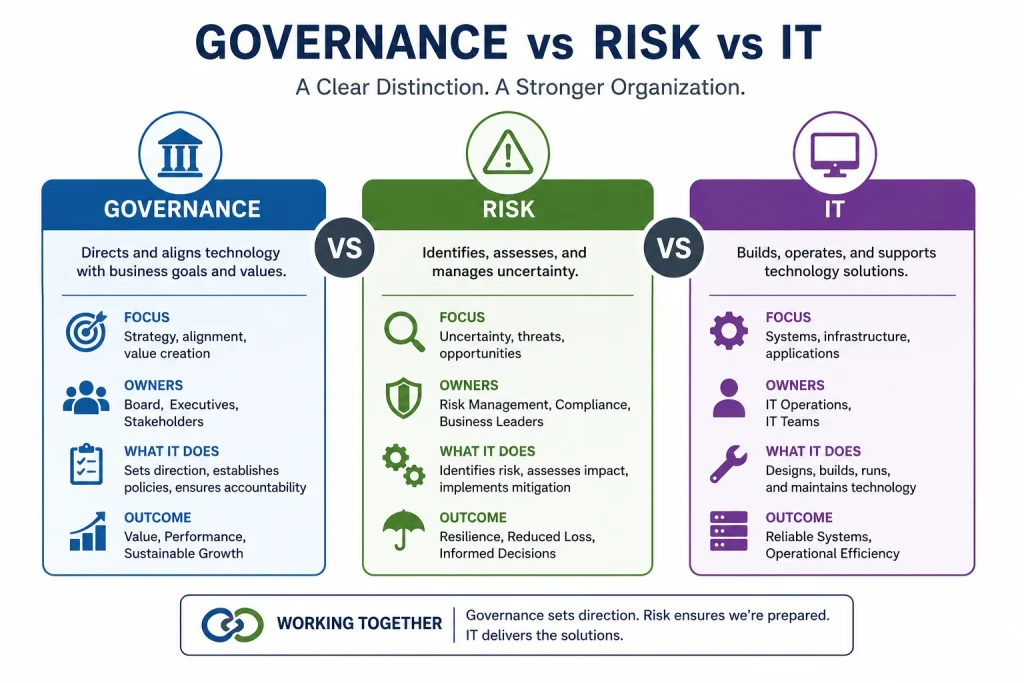
These three terms get used interchangeably, and that confusion is itself a governance failure. Here’s the actual division of labor.
| Function | Core question it answers | Who typically owns it | Failure mode if missing |
| IT / Technology controls | Does the system run reliably and securely? | Engineering, security | Downtime, breaches, technical debt |
| Risk management | What could go wrong, and how likely is it? | Enterprise risk, compliance | Unquantified exposure, surprise losses |
| AI governance | Who decided this was acceptable, and who answers for it? | Executive leadership, AI governance committee | Unowned harm, regulatory penalty, reputational loss |
Governance is the layer that connects the other two to actual authority. A risk register that nobody with power reviews is decoration. A model validated by engineering but never approved by an accountable executive is a liability waiting for a name.
Who Should Own AI Decisions? Building Real Decision Rights
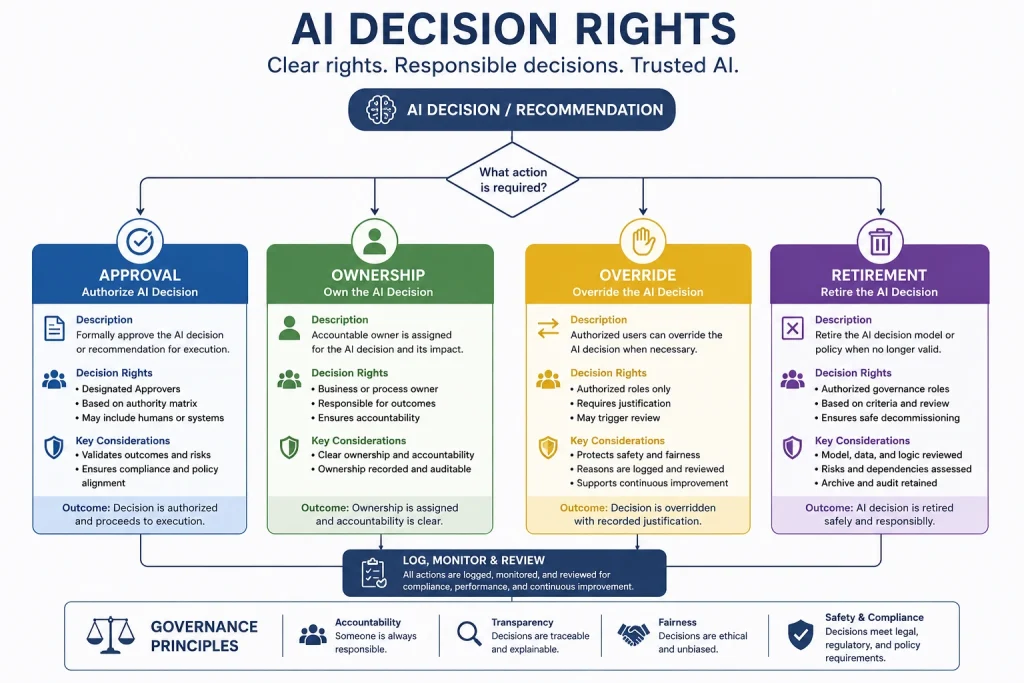
Decision rights are the single most under,built part of enterprise AI programs. Most companies can describe what their AI does. Very few can name, without hesitation, the person accountable when it’s wrong.
Every AI system that touches a consequential outcome , credit decisions, hiring, pricing, medical triage, safety,critical operations , needs answers to four questions before it goes live:
- Who approves deployment? A named individual or committee, not a department.
- Who owns the outcome? One accountable person, reachable in an incident, not a shared inbox.
- Who can override the system in real time? A defined escalation path with response,time expectations.
- Who retires the system when it’s no longer safe or accurate? Decommissioning needs the same rigor as launch.
Practical example: A regional bank rolling out an AI,based fraud detection agent assigned a single VP of Fraud Operations as the decision,rights owner. When the model started flagging an unusual volume of false positives during a promotional campaign, the escalation path routed the anomaly to that VP within two hours , not two weeks. That speed is what a functioning decision,rights structure buys you.
Expert tip
Write decision rights into the system’s deployment ticket, not a separate governance document nobody reads during an incident. If the on,call engineer can’t find the accountable owner in the same place they find the runbook, the decision right doesn’t functionally exist.
Why Agentic AI Broke the Old Governance Playbook
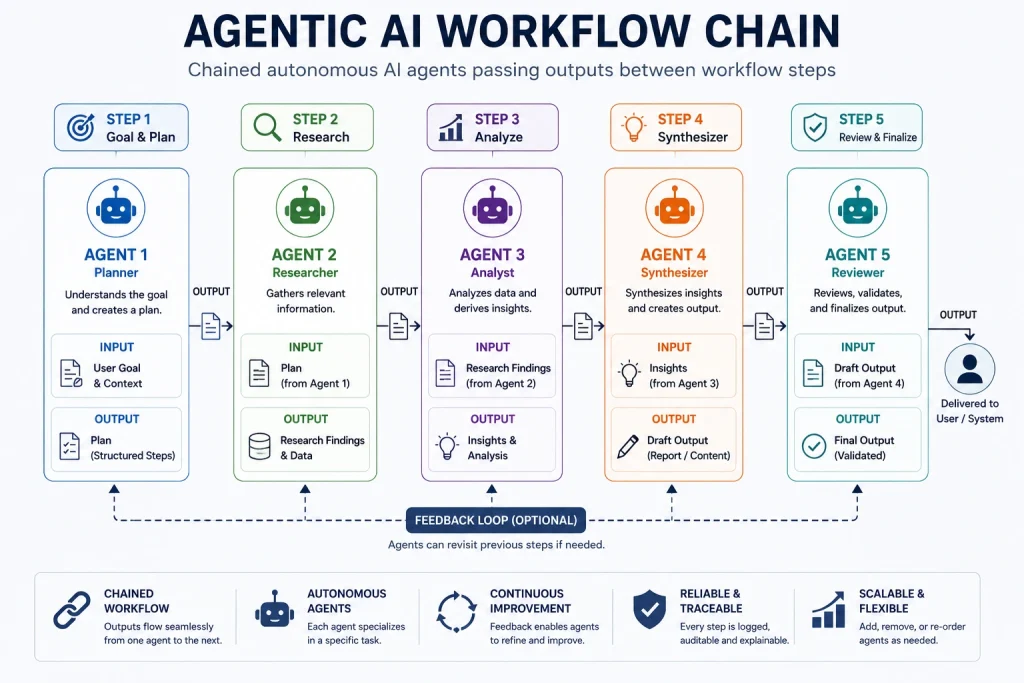
Traditional software governance assumed a human clicked “submit.” Agentic AI removes that click. An agent can now query a database, draft a communication, execute a transaction, and trigger a downstream workflow , without a person in the loop at each step.
A 2024 global survey found 40% of respondents believed their organization’s AI governance program was insufficient , before most agentic deployments even scaled. That gap has only widened as agents moved from pilots to production.
Three structural shifts explain why agentic systems demand a different governance model:
- Speed of action. A human process error affects one transaction at a time. An unsupervised agent can repeat an error thousands of times before anyone notices.
- Chained autonomy. One agent’s output becomes another agent’s input. An error doesn’t stay contained , it propagates across a workflow no single team fully owns.
- Identity ambiguity. Enterprises are now building agent identity systems that extend Zero Trust infrastructure to multi,agent workflows, because “who did this” is no longer a question with an obvious human answer.
Gartner expects more than 40% of agentic AI projects to be canceled by the end of 2027, with escalating costs, unclear business value, and inadequate risk controls cited as the primary drivers. Governance failure, not model failure, is what kills these projects.
The Six Governance Gaps That Kill AI Programs
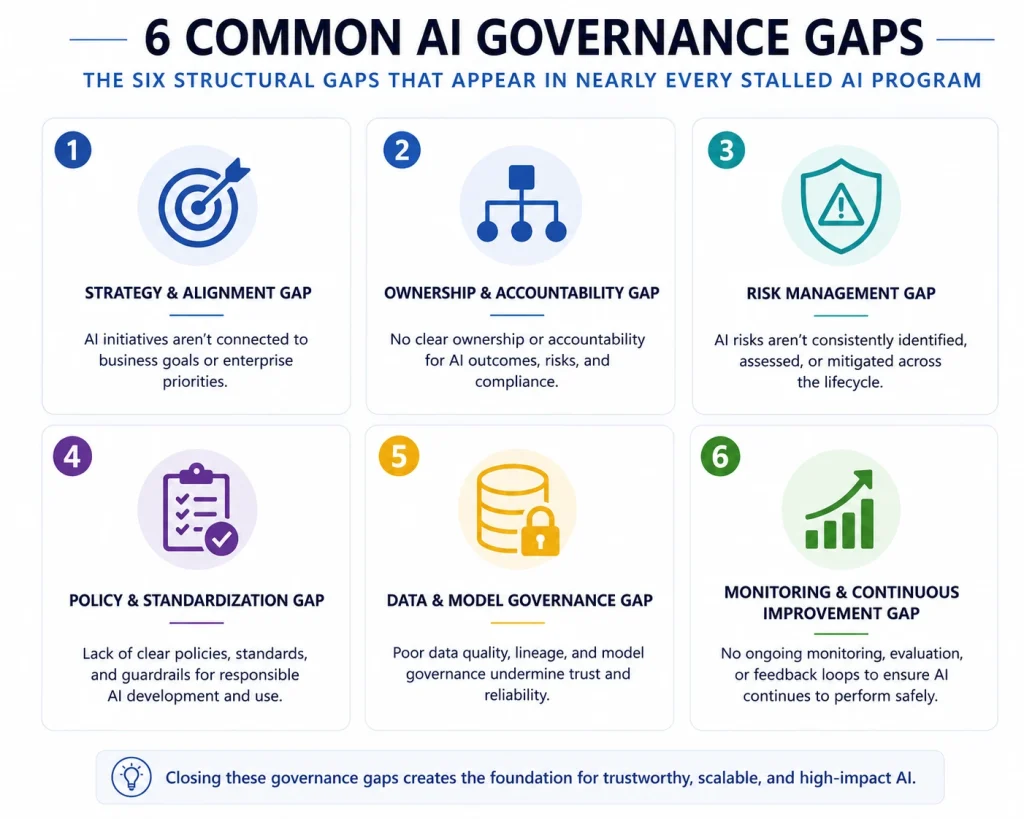
Most AI programs don’t collapse dramatically. They stall quietly, and by the time leadership notices, the political capital to fix the root cause is gone. These six gaps show up in nearly every stalled program.
- No enterprise,level owner of AI strategy. AI leads exist without cross,functional authority, so initiatives duplicate and no one owns the roadmap.
- Board oversight that arrives too late. Quarterly summaries mean the board learns about a problem after the damage is already done.
- Inconsistent data standards across business units. Different quality and retention rules feed the same model, producing outputs no one can defend to a regulator.
- No retraining or drift,monitoring schedule. A model’s accuracy degrades silently as real,world conditions shift away from its training data.
- No defined escalation chain for anomalies. When something looks wrong, nobody knows who is supposed to act, or how fast.
- Ethics commitments with no enforcement mechanism. A public AI ethics statement without a metric attached to it is a press release, not a control.
The Seven Pillars of a Working AI Governance Framework
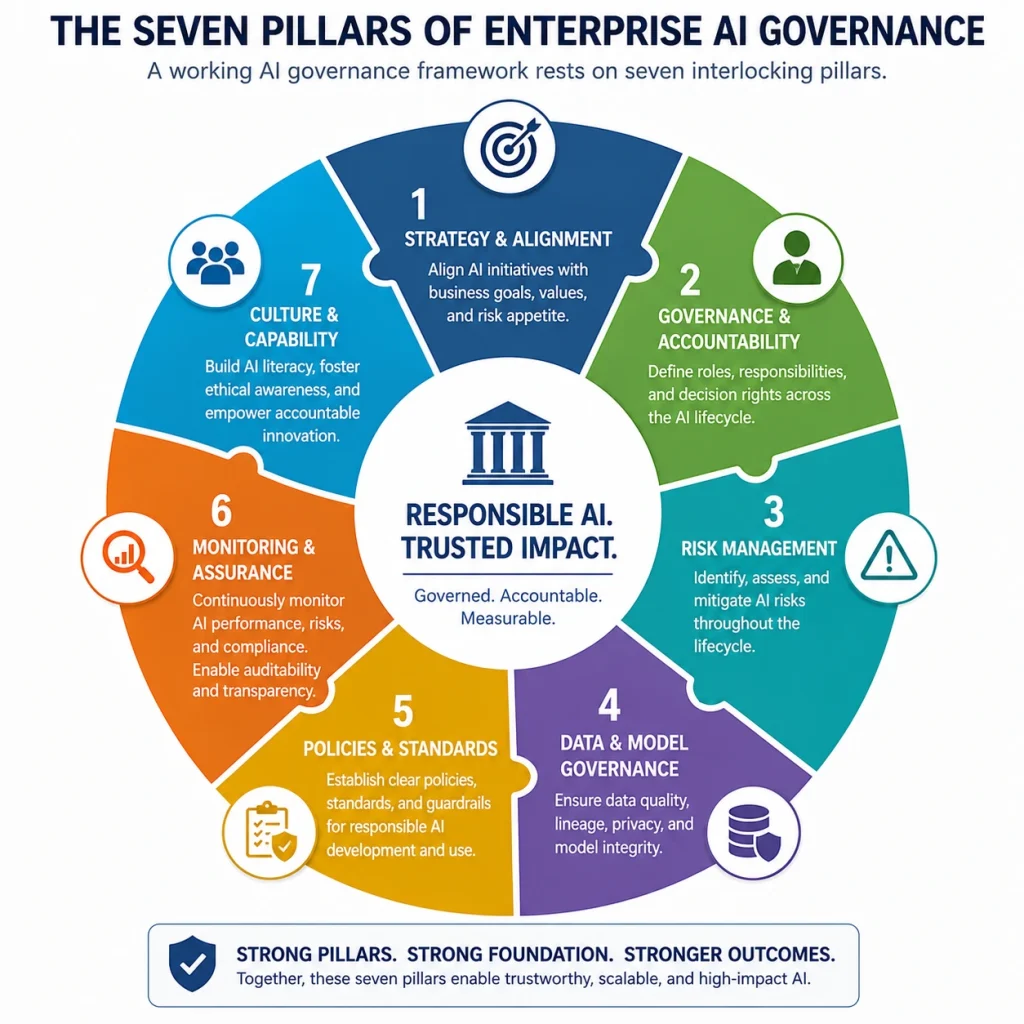
A governance framework that actually functions rests on seven interlocking pillars. Remove any one and the structure becomes decorative.
1. Data governance and lineage
Every model is only as trustworthy as the data behind it. This pillar defines ownership, quality thresholds, retention rules, and cross,border transfer rules , and makes data lineage traceable end to end.
2. Risk classification
Every AI use case gets sorted by risk level (low, medium, high, unacceptable) using consistent criteria, so governance effort is proportional to actual exposure instead of spread evenly and thinly.
3. Model lifecycle management
Validation, documentation, deployment approval, drift monitoring, and retirement are standardized across every model , not handled ad hoc by whichever team built it.
4. Human,in,the,loop thresholds
High,risk decisions get a defined review point. This isn’t a vote of no confidence in the model; it’s the difference between a governed system and an unmanaged one.
5. Transparency and explainability
If a regulator, customer, or board member asks “why did the system decide this,” there must be an answer that doesn’t require reverse,engineering the model weights.
6. Continuous monitoring and audit trails
Companies including Uber built an LLM gateway handling PII redaction, access control, and audit logging across every model interaction, plus an agent identity system with cryptographically attested lineage on every tool call. Static annual audits do not work for systems that change behavior in real time.
7. Accountable ownership and enforcement
Every pillar above is meaningless without a named person whose job depends on it working. Enforcement, not intention, is what separates governance from a mission statement.
The AI Governance Maturity Model
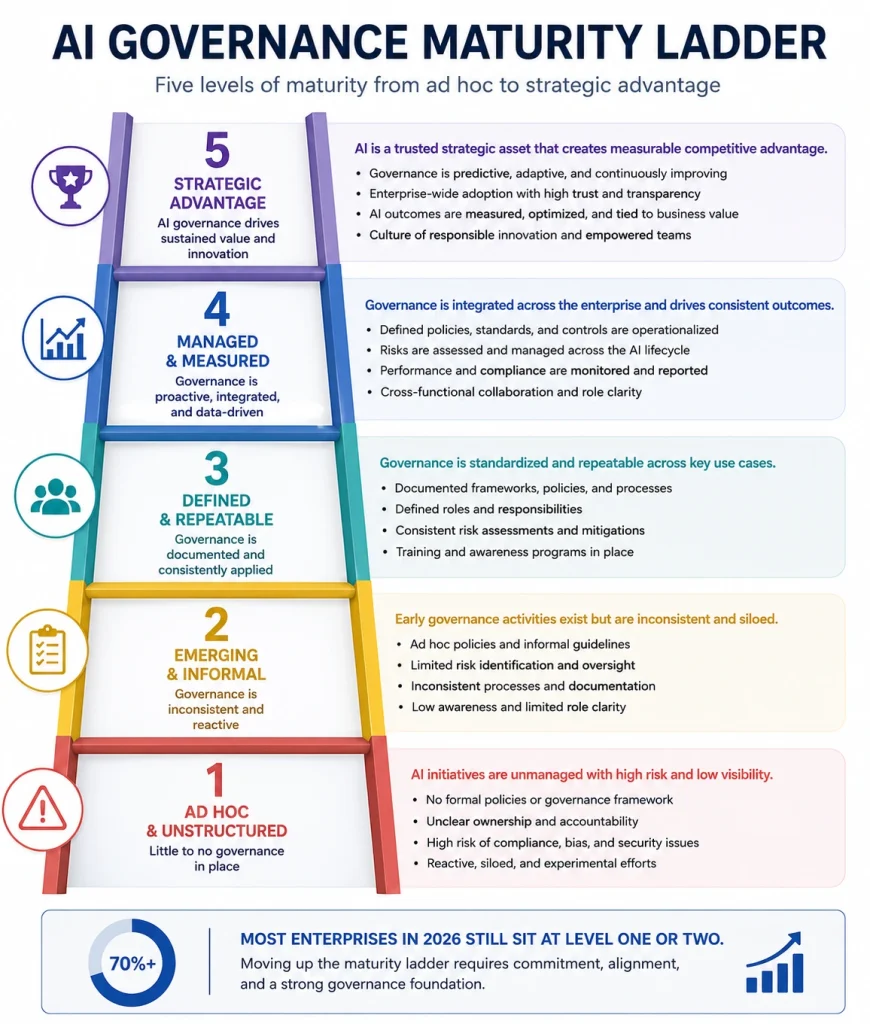
Governance maturity is a spectrum, not a switch. Knowing exactly where your organization sits determines what your next move should be.
| Level | Description | Typical risk | What moves you to the next level |
| 1. Ad hoc | Uncoordinated experimentation, no inventory of AI in use | Invisible exposure, shadow AI everywhere | A full AI use,case inventory |
| 2. Controlled pilots | Isolated projects with light documentation | No path to enterprise scale | Named executive ownership |
| 3. Structured framework | Formal policy exists, risk classification applied | Framework exists but enforcement is weak | Monitoring dashboards with real consequences |
| 4. Operating model | Governance standardized across departments | Integration gaps as use cases multiply | Cross,functional governance committee with veto power |
| 5. Strategic advantage | Governance is a trust signal customers and regulators recognize | Complacency as the landscape shifts | Continuous framework review tied to regulatory change |
Only 30% of organizations have reached maturity level three or higher in strategy, governance, and agentic AI controls , meaning most enterprises are still scaling agents on a governance foundation built for a different era.
A 90,Day Roadmap to Operational AI Governance
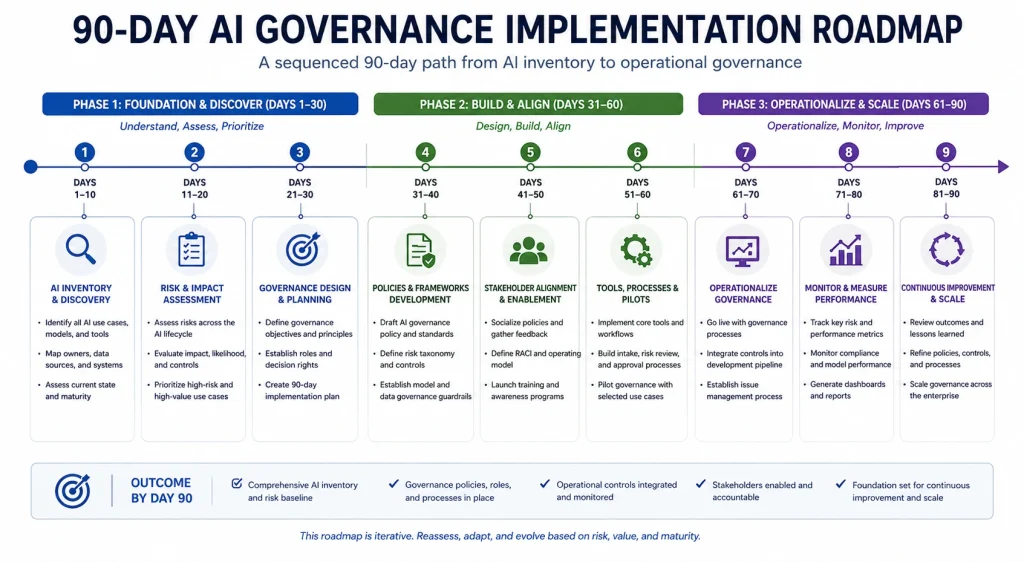
Governance is not a single project with an end date. But you can stand up a working foundation in a quarter if you sequence it correctly.
Days 1–15: Inventory and risk appetite. Catalog every AI system and tool in active use, including shadow AI. Define, with the executive team, what level of risk the business is willing to accept.
Days 16–30: Assign real ownership. Name the individual or committee with actual authority over governance outcomes , not just project delivery. Authority and accountability must move together, or accountability has no teeth.
Days 31–45: Classify and prioritize. Sort every AI use case by risk level. Pick the single highest,risk, highest,visibility system and build the full governance stack around it first. This becomes your internal template.
Days 46–60: Build the data and model lifecycle controls. Define data quality standards, lineage requirements, and a repeatable validation,to,retirement process for every model.
Days 61–75: Stand up monitoring and escalation. Build dashboards that track drift, anomalies, and policy adherence in near real time, with a documented escalation chain and defined response,time expectations.
Days 76–90: Convert ethics principles into enforceable policy. Translate any existing AI ethics commitments into measurable controls with named owners and real consequences for breach. Schedule the first recurring audit.
Common pitfall to avoid during rollout
Do not try to govern everything at once. Enterprises that attempt enterprise,wide governance in one motion typically stall in month two because the scope outpaces available executive attention. Sequential, high,risk,first governance produces faster, more durable wins.
Governance by Industry: What Changes and What Doesn’t
The seven pillars apply everywhere, but risk weighting shifts by sector.
| Industry | Highest,stakes AI use case | Primary regulatory pressure | Governance emphasis |
| Financial services | Credit scoring, fraud detection, trading agents | EU AI Act, model risk management regulation | Explainability, audit trails, board reporting |
| Healthcare | Clinical decision support, triage, diagnostics | HIPAA, FDA guidance, EU AI Act high,risk category | Human,in,the,loop, data privacy, safety validation |
| Retail / e,commerce | Dynamic pricing, personalization, inventory agents | Consumer protection, data privacy law | Bias monitoring, transparency in pricing logic |
| Manufacturing / logistics | Autonomous scheduling, predictive maintenance agents | Workplace safety regulation, physical AI oversight | Kill,switch design, human override, safety interlocks |
| Public sector | Eligibility determination, resource allocation | Administrative law, algorithmic accountability statutes | Explainability, appeal rights, audit transparency |
73% of healthcare AI agent deployments reportedly fail HIPAA compliance because standard AI architectures violate Technical Safeguards mandates, with violations carrying potential fines of $1.5 million and breach costs averaging $7.42 million. That single statistic illustrates why industry,specific governance calibration is not optional in regulated sectors.
Pros and Cons of Formal AI Governance
| Pros | Cons |
| Reduces regulatory and legal exposure | Adds process overhead, especially early on |
| Builds trust with customers, regulators, and boards | Requires sustained executive attention, not a one,time project |
| Moves roughly 12x more AI projects into production | Can slow initial pilots if applied too broadly, too soon |
| Improves model reliability through structured monitoring | Requires new skills many teams don’t yet have (AI risk, model auditing) |
| Creates a defensible audit trail before incidents happen | Costs real budget , though far less than retrofitting after a failure |
The net calculation, based on current data, favors governance clearly: the cost of building it is a fraction of the cost of retrofitting it after a public failure or regulatory penalty.
Common Mistakes Enterprises Make
- Treating governance as a compliance checkbox instead of an operating capability. Checklists get filed. Operating capabilities get used.
- Appointing an AI lead without enterprise authority. A title without power over budget or veto rights is a placeholder, not a governance structure.
- Ignoring shadow AI. 67% of executives believe their organization has already suffered a data leak through unapproved AI tools, and 35% of employees have entered proprietary company information into public AI tools. Shadow AI is almost always larger than the official program.
- Building governance only for generative AI chatbots, not agents. The risk profile of an autonomous agent taking actions is categorically different from a chatbot drafting text.
- Waiting for a regulatory deadline to start. <cite index=”8,1″>78% of enterprises are reportedly unprepared for their obligations under the EU AI Act, whose full high,risk enforcement provisions took effect in August 2026 , leaving very little runway for last,minute compliance.
- Publishing ethics principles with no enforcement metric attached. A principle without a consequence changes nothing.
Best Practices From Companies Doing This Well
- Name a single accountable executive early. <cite index=”8,1″>Chief AI Officer adoption jumped from roughly 26% of organizations in 2025 to 76% in 2026, reflecting how quickly this role has moved from optional to standard.
- Build the control plane before scaling adoption. Uber built an LLM gateway, an MCP gateway and registry governing every agent,to,tool connection across more than 10,000 internal services, and an agent identity system before scaling agent adoption company,wide.
- Give governance real veto power, not advisory status. Governance committees that can only recommend, not block, get routinely overruled by delivery pressure.
- Instrument everything before launch, not after. Monitoring and audit logging built into the architecture from day one costs a fraction of what retrofitting costs post,incident.
- Tie governance maturity to business outcomes leadership already tracks. Morgan Stanley and BlackRock reportedly now factor AI governance maturity into company valuations , a signal that governance has moved from a risk topic to a value topic at the investor level.
Future Trends: Where AI Governance Is Headed
- Governance platforms become a standalone spending category. Gartner projects the AI governance platform market will reach $492 million in 2026 and exceed $1 billion by 2030, and organizations that deploy dedicated AI governance platforms are 3.4 times more likely to achieve high effectiveness in their governance programs.
- Agent identity becomes its own discipline. As agents act on systems independently, enterprises are extending Zero Trust and SSO infrastructure to non,human identities, treating an agent’s access rights the same way they treat an employee’s.
- ERP and cloud vendors embed governance natively. Half of enterprise ERP vendors are expected to launch autonomous governance modules combining explainable AI, automated audit trails, and real,time compliance monitoring in 2026, reducing how much enterprises must build from scratch.
- Board,level accountability keeps rising. Board oversight of AI has increased 84% in public company disclosures, signaling that governance reporting is shifting from a quarterly technical update to a standing board responsibility.
- Regulatory enforcement moves from guidance to penalty. With the EU AI Act’s high,risk provisions now active and equivalent frameworks maturing in the UK, US, and Gulf markets, 2027 is expected to be the first year enforcement actions, not just guidance documents, shape enterprise behavior.
Expert Verdict
AI governance in 2026 has stopped being a compliance nice,to,have and become the clearest predictor of whether an AI investment pays off. The data across nearly every major research firm this year points to the same conclusion: companies with structured governance move dramatically more AI systems into production, avoid a disproportionate share of breaches and incidents, and are increasingly valued differently by investors because of it.
The organizations winning right now are not the ones with the most advanced models. They are the ones that treated accountability, monitoring, and decision rights as seriously as they treated the model itself , and did it before scaling, not after an incident forced the issue.
Final Words
The technology behind enterprise AI is no longer the constraint. Governance is. Every statistic from this year , the adoption,versus,maturity gap, the incident counts, the ROI numbers , tells the same story from a different angle: enterprises that build accountable, monitored, well,owned AI systems get more value out of AI, with less risk, than enterprises that scale first and figure out oversight later.
If your organization has models in production, agents taking real actions, or a roadmap that assumes both will grow, the governance conversation is no longer optional and no longer something to defer to next quarter’s planning cycle. Start with an honest inventory of what you have running today, name one person with real authority, and build the full governance stack around your single highest,risk system first. That one system becomes the template for everything that follows.
Ai Tools Reviews Click Here
Frequently Asked Questions
Why is AI transformation a governance problem rather than a technology problem?
Because most AI failures trace back to unclear accountability , who approved the system, who monitors it, who acts when it errs , not to model accuracy. The technology usually works; the oversight structure around it usually doesn’t.
What is the difference between AI governance and AI risk management?
Risk management identifies and quantifies what could go wrong. Governance assigns the authority and accountability to act on that information, including who approves deployment and who owns the outcome.
What is agentic AI governance?
Agentic AI governance is the set of controls specific to autonomous systems that act without a human approving each step , including agent identity management, kill,switch capability, and real,time monitoring of chained actions across workflows.
What is shadow AI, and why does it matter?
Shadow AI refers to AI tools employees adopt without formal review or approval. It creates risk because sensitive data may reach unvetted external systems with no organizational visibility or control.
What are the seven pillars of an AI governance framework?
Data governance, risk classification, model lifecycle management, human,in,the,loop oversight, transparency and explainability, continuous monitoring, and accountable enforcement.
What is the AI governance maturity model?
A five,level spectrum ranging from ad hoc experimentation to governance functioning as a strategic, trust,building advantage. Most enterprises currently sit at level one or two.
How long does it take to build a working AI governance framework?
A functional foundation can be stood up in roughly 90 days if you sequence inventory, ownership, risk classification, and monitoring in that order, starting with your highest,risk system first.
Does the EU AI Act apply to companies outside Europe?
Yes, if the company’s AI systems are used by or affect people located in the EU, regardless of where the company is headquartered. Consult legal counsel for system,specific obligations.
Can a mid,size company build effective AI governance without a large compliance team?
Yes. It requires clear ownership, documented decision rights, risk classification of AI use cases, and basic monitoring , not a department of twenty people.
What is a Chief AI Officer, and does every company need one?
A Chief AI Officer holds enterprise,wide accountability for AI strategy and governance outcomes. Adoption of the role has grown rapidly, and it is increasingly the default for mid,size and large enterprises deploying AI at scale
How do you measure whether AI governance is actually working?
Track drift,detection speed, time to escalation, the ratio of governed to ungoverned AI systems in production, and audit readiness. If you cannot name who owns a given model and when it was last reviewed, governance is not yet operational.