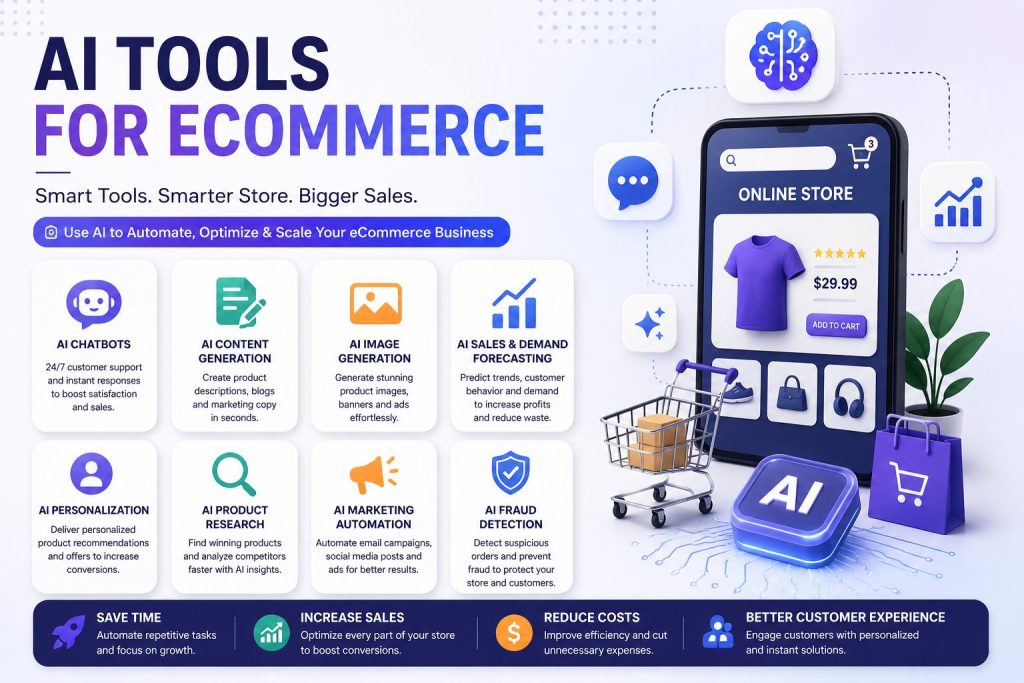
You already know AI is changing ecommerce. What you actually need to know is which tools are worth your money and which ones make big promises but barely move the needle.
This guide is built for store owners, Shopify sellers, Amazon sellers, WooCommerce users, Etsy creators, dropshippers, and ecommerce marketers who want real answers. We cover what each AI tool does, what it costs, who it’s for, and whether it earns its spot in your stack.
No fluff. No filler. Just the AI tools for ecommerce that actually work.
1. What Are AI Tools for Ecommerce?
AI tools for ecommerce are software applications that use machine learning, natural language processing, and predictive analytics to automate and improve how online stores operate.
They connect to your store platform Shopify, WooCommerce, Amazon Seller Central, Etsy, and others and use your data to generate content, predict customer behavior, personalize shopping experiences, answer support tickets, and optimize pricing.
Here’s what makes AI tools for ecommerce different from regular software: they learn. A standard email platform sends emails on a schedule. An AI email platform analyzes your customer data, predicts who is about to churn, and automatically sends the right message at the right time without you lifting a finger.
According to Google’s Search Central guidelines on helpful content, the best content serves users with genuine expertise and depth which is exactly the bar the best AI tools for ecommerce should help you meet, not undercut.
In 2026, AI tools for ecommerce span seven main categories:
- Content creation – product descriptions, ad copy, email campaigns, blog posts
- Customer support – AI chatbots and ticketing automation
- Personalization – product recommendations, dynamic site content
- Email and SMS marketing – predictive flows, segmentation, send-time optimization
- SEO – keyword research, content scoring, on-page optimization
- Pricing and inventory – dynamic repricing, demand forecasting, stock alerts
- Visual assets – AI image generation, background removal, photo editing
Practical Takeaway: Before you buy anything, identify your biggest operational bottleneck. The right AI tools for ecommerce are the ones that solve your most expensive problem first.
2. Why Every Online Store Needs AI Tools for Ecommerce Right Now
Three years ago, AI tools for ecommerce were a competitive edge. In 2026, they are table stakes.
More than half of all retailers now use AI tools for ecommerce for at least one core function demand forecasting, personalization, or inventory optimization. That number keeps climbing because the ROI is real. Businesses that adopt AI-driven automation report up to 30% improvements in operational efficiency, and global spending on AI systems is projected to surpass $300 billion in 2026.
For online stores specifically, the shift comes down to four pressures:
Rising ad costs. Meta and Google have moved targeting and bidding inside their own AI systems. You no longer control audiences manually you feed the machine better creative, cleaner data, and accurate conversion signals. Without AI tools for ecommerce helping you do that at scale, you’re at a disadvantage against competitors who use them. Shopify’s commerce research shows that brands using AI-assisted ad creative consistently outperform those that don’t.
Customer expectations. Shoppers now expect personalized product recommendations, instant support responses, and emails that feel hand-written. Meeting that expectation manually is impossible at scale. AI tools for ecommerce make it feasible for a two-person team.
Content at volume. Product descriptions, ad variants, email subject lines, blog posts, category copy an active ecommerce store needs thousands of pieces of content. AI tools for ecommerce can produce a first draft in seconds and let your team focus on editing and strategy instead of starting from scratch.
Margin pressure. Competing on price without dynamic pricing automation means someone with AI tools will undercut you and win the Buy Box before you even check your dashboard.
Practical Takeaway: You don’t need every AI tool for ecommerce. You need the right three to four, integrated properly and measured against real revenue metrics.
3. How AI Tools for Ecommerce Increase Revenue
AI tools for ecommerce generate revenue through five core mechanisms:
Conversion rate improvement. AI-powered product recommendations and personalized onsite experiences guide shoppers toward the products most likely to convert. One fashion brand using a quiz-based AI recommendation engine reported a 46% conversion rate on quiz traffic versus 3.2% for standard product page traffic.
Average order value (AOV) lift. Smart upsell and cross-sell tools use AI to suggest complementary products at checkout based on cart contents, purchase history, and what similar customers bought. Even a small increase in AOV compounds significantly over thousands of orders.
Abandoned cart recovery. AI tools for ecommerce cart recovery don’t just send a timed email they predict abandonment before it happens using behavioral signals and intervene at the highest-risk moment, including for anonymous visitors that email flows can’t reach.
Customer retention. Predictive analytics identify customers at risk of churning before they leave. Klaviyo’s AI, for example, calculates next predicted purchase dates and flags customers who are overdue, enabling automatic win-back campaigns before the relationship goes cold.
Cost reduction. Every support ticket resolved by an AI agent, every product description generated in seconds instead of hours, and every pricing update automated instead of manually checked is a direct reduction in operational cost.
Practical Takeaway: Measure AI tools for ecommerce against specific KPIs conversion rate, AOV, support cost per ticket, and email revenue per recipient. If a tool doesn’t move one of those numbers, cut it.
4. The Best AI Tools for Ecommerce in 2026
Below is a detailed breakdown of the top AI tools for ecommerce available right now. Each review covers features, pricing, pros, cons, and an honest verdict on who should and shouldn’t use it.
| Tool | Best For | Starting Price | Rating |
| Jasper AI | High-volume content | $39/month | 4.2/5 |
| ChatGPT | Versatile content tasks | $20/month | 4.5/5 |
| Claude | Long-form & analysis | $20/month | 4.3/5 |
| Shopify Magic | Shopify sellers | Free | 4.6/5 |
| Klaviyo AI | Email & SMS marketing | Free / $20+ | 4.7/5 |
| Surfer SEO | Content optimization | $69/month | 4.1/5 |
| Writesonic | Budget content tool | $16/month | 3.9/5 |
| Canva AI | Visual content | $15/month | 4.4/5 |
| Midjourney | Marketing imagery | $10/month | 3.8/5 |
| Perplexity | Market research | Free / $20 | 4.0/5 |
| HubSpot AI | CRM + marketing | $15/seat/month | 4.0/5 |
| Copy.ai | Team workflows | $36/month | 3.7/5 |
Jasper AI Best AI Tool for Ecommerce Content at Scale
Overview

Jasper AI is one of the most established AI tools for ecommerce content generation, built specifically for marketing teams. It combines multiple AI models with brand voice training so the copy it produces sounds like you, not a generic template.
For ecommerce, Jasper is most useful when you have a large product catalog and need to produce hundreds or thousands of product descriptions, email campaigns, meta titles, and ad variants without hiring a full content team. Learn more at jasper.ai.
Best Features
- Brand voice training across your existing content
- Bulk product description generation from specs or bullet points
- Templates for Amazon listings, Shopify product pages, Google ads, and email campaigns
- Jasper Art for generating marketing images alongside copy
- Team collaboration and approval workflows
Pricing
Jasper offers a Creator plan at $39/month and a Pro plan at $59/month (billed annually). Team and business plans are available at custom pricing. A 7-day free trial is offered. Pricing has shifted over time, so verify current rates at jasper.ai before purchasing.
Pros
- Excellent for high-volume content production
- Brand voice feature reduces editing time significantly
- Strong template library covering ecommerce-specific formats
- Works across Shopify, Amazon, WooCommerce, and Etsy use cases
Cons
- Content still requires human editing for accuracy and product-specific claims
- Higher cost than general-purpose AI tools for ecommerce like ChatGPT
- AI-generated copy can drift from brand voice without regular retraining
Who Should Use It
Mid-size to large ecommerce brands with catalogs of 50+ products that need consistent, on-brand copy at scale. Also well-suited for ecommerce agencies managing multiple clients.
Who Should Avoid It
Solo sellers or very small stores with fewer than 20 products. At that scale, ChatGPT or Shopify Magic delivers similar output at a lower cost.
Real Use Case
A WooCommerce home goods store with 200+ SKUs used Jasper to regenerate all product descriptions with SEO-optimized copy and consistent brand tone in one week a task that previously took three months with a freelance writer.
Expert Verdict
Jasper earns its price when volume and brand consistency are both priorities. For smaller operations, it’s overkill. Rating: 4.2/5
ChatGPT Most Versatile AI Tool for Ecommerce Sellers
Overview
ChatGPT from OpenAI is the Swiss Army knife of AI tools for ecommerce. It doesn’t specialize in ecommerce, but its flexibility makes it genuinely useful across almost every content and research task an online store faces.
Most ecommerce sellers use it for product descriptions, ad copy, email drafts, customer support script writing, keyword brainstorming, competitor analysis prompts, and supplier communication.
Best Features
- Flexible enough to handle almost any text-based task
- GPT-4o supports image input upload a product photo and ask for a description
- Web search integration (with ChatGPT Plus) for real-time research
- Custom GPTs for building specialized ecommerce workflows
- API access for building automated pipelines
Pricing
ChatGPT Free offers limited access to GPT-4o. ChatGPT Plus costs $20/month and includes expanded access, image generation via DALL-E, and web browsing. Verify current pricing at openai.com.
Pros
- Extremely versatile useful for nearly every ecommerce content task
- Low cost relative to specialized AI tools for ecommerce
- Image input makes it useful for product-based prompting
- Widely documented prompt strategies for ecommerce
Cons
- No native ecommerce platform integrations
- Requires well-crafted prompts to produce useful output
- Results vary significantly based on how you write your prompts
- No brand voice memory without custom GPT setup
Who Should Use It
Every ecommerce operator. Even sellers using Jasper or Shopify Magic benefit from keeping ChatGPT Plus for research, brainstorming, and one-off content tasks.
Who Should Avoid It
Those expecting plug-and-play output without any prompt writing. ChatGPT rewards users who learn to prompt well.
Real Use Case
An Etsy seller used ChatGPT to generate 50 listing descriptions from product photos in a single afternoon feeding each image with a short prompt about materials and target buyer. Output needed light editing but replaced what would have been two days of writing.
Expert Verdict
At $20/month, ChatGPT Plus is arguably the highest-value AI tool for ecommerce sellers. It belongs in every stack. Rating: 4.5/5
Claude Best AI Tool for Ecommerce Long-Form Content and Analysis
Overview
Claude, developed by Anthropic, is an AI tool known for producing longer, more nuanced text output with strong reasoning capabilities. For ecommerce, its strength lies in tasks that require structured thinking writing policies, analyzing customer feedback, drafting detailed email sequences, or reviewing ad copy for logic and clarity.
Best Features
- Handles very long documents and inputs (useful for reviewing product catalogs or analyzing reviews in bulk)
- Strong at structured writing: email sequences, policy pages, FAQs, return policies
- Thoughtful reasoning makes it useful for strategy brainstorming
- Less prone to hallucination on factual claims than older models
Pricing
Claude offers a free tier. Claude Pro is available at $20/month. Team and API plans are available for businesses. Check current pricing at claude.ai.
Pros
- Excellent for long-form and structured content
- Strong reasoning makes it useful for strategy and analysis tasks
- Handles complex multi-part prompts reliably
- Good at maintaining tone across a long piece of content
Cons
- Less specialized ecommerce output than Jasper
- No native integrations with Shopify or other platforms
- Best results still require thoughtful prompting
Who Should Use It
Ecommerce teams that produce a lot of long-form content, email sequences, policy pages, or customer communications. Also useful for analyzing review data and extracting actionable insights.
Who Should Avoid It
Sellers who need quick, high-volume product descriptions with minimal prompt effort Jasper or Shopify Magic are faster for that use case.
Real Use Case
An ecommerce brand used Claude to analyze 500 customer reviews in bulk, identifying the three most common objections. That insight was used to rewrite product page copy and reduced return rates by 12% over 60 days.
Expert Verdict
Claude excels at quality over quantity. Pair it with a higher-volume tool for the best results. Rating: 4.3/5
Shopify Magic Best Free AI Tool for Ecommerce on Shopify
Overview
Shopify Magic is the built-in AI suite inside Shopify’s admin panel and it’s free for all Shopify users. If you’re on Shopify and not using Shopify Magic, you’re leaving free value on the table.
As of Shopify’s Winter 2026 Edition, Shopify Magic includes over 150 AI-powered features: product description generation, email campaign writing, image background removal, AI-generated media, customer chat suggestions through Shopify Inbox, and a conversational store management assistant called Sidekick.
Best Features
- Product descriptions generated from a few keywords or bullet points
- Email campaign copy with subject line suggestions
- AI background removal and image generation for product photos
- Sidekick: manage store operations through natural language commands
- Brand voice cloning from your existing store content
Pricing
Free for all Shopify merchants. Included in every plan.
Pros
- Zero additional cost the best-value AI tool for ecommerce on Shopify
- Deeply integrated into the Shopify workflow
- Sidekick can execute tasks (create discount codes, analyze sales) directly in admin
- Brand voice cloning keeps output consistent with your store tone
Cons
- Quality lags behind dedicated AI tools for ecommerce like Jasper for high-volume, complex copy
- Limited to Shopify no value if you’re on WooCommerce or Amazon
- Sidekick is still evolving and occasionally gives incomplete answers
Who Should Use It
Every Shopify merchant, full stop. It’s free and handles the basics extremely well.
Who Should Avoid It
Non-Shopify sellers. For WooCommerce, Amazon, or Etsy stores, there is no equivalent built-in tool.
Real Use Case
A Shopify fashion brand used Magic to write product descriptions for 85 new SKUs at launch, cutting content preparation time from two weeks to two days.
Expert Verdict
The best free AI tool in ecommerce, specifically because it’s embedded where you already work. Use it first. Rating: 4.6/5
Klaviyo AI Best AI Tool for Ecommerce Email Marketing
Overview
Klaviyo is the dominant email and SMS platform for ecommerce, and its AI features are what separate it from basic email tools. Klaviyo’s AI analyzes your customer data to predict behavior, automate personalized flows, and surface insights you’d miss with manual segmentation.
As Klaviyo’s own documentation explains, the platform uses machine learning to predict customer lifetime value, next purchase dates, and churn risk making it one of the most powerful AI tools for ecommerce email available today.
Best Features
- Predictive analytics: next purchase date, churn risk, lifetime value predictions
- AI-powered segmentation using purchase history and behavioral signals
- Automated flows: abandoned cart, welcome series, win-back campaigns
- Subject line generation and send-time optimization
- Deep Shopify, WooCommerce, and BigCommerce integrations
Pricing
Free up to 250 contacts. Paid plans start around $20/month and scale with list size. Verify current pricing at klaviyo.com.
Pros
- Best-in-class predictive analytics among AI tools for ecommerce email
- Automated flows are set-and-forget once configured properly
- Integration depth with Shopify is unmatched
- Revenue attribution dashboard shows exactly what each campaign earns
Cons
- Costs scale quickly as your contact list grows
- Setup and segmentation logic require time investment upfront
- Can get expensive for stores with large lists but low email engagement
Who Should Use It
Any ecommerce brand where email and SMS are revenue drivers. That’s most stores doing more than $10,000/month.
Who Should Avoid It
Very early-stage stores with under 500 contacts at that size, the free tier covers your needs and free alternatives like Mailchimp work fine.
Real Use Case
A DTC supplement brand used Klaviyo’s churn prediction to identify 1,200 at-risk customers and send a targeted win-back sequence. That campaign generated $18,000 in revenue from customers who would otherwise have lapsed.
Expert Verdict
Klaviyo is the gold standard for ecommerce email. If email is a meaningful revenue channel, this is a must-have. Rating: 4.7/5
Surfer SEO Best AI Tool for Ecommerce Content Optimization

Overview
Surfer SEO analyzes your store’s content against the top-ranking pages for any target keyword and gives you a data-driven content score with specific recommendations: keyword usage, content length, heading structure, and competitor gaps.
For ecommerce, it’s most valuable as an AI tool for category pages, blog content, and long-form buying guides not short product descriptions. Learn more at surferseo.com.
Best Features
- Content editor with real-time keyword and structure scoring
- Keyword research integrated with SERP analysis
- Competitor content gap identification
- AI-assisted content generation within the editor
- Audit tool for optimizing existing pages
Pricing
Plans start at $69/month. Verify current pricing at surferseo.com.
Pros
- Significantly reduces content research time
- Good at identifying structural weaknesses in category pages
- Competitor benchmarking is actionable and specific
- Integrates with Google Docs and WordPress
Cons
- Less useful for short product descriptions
- AI-generated content optimized for keywords can read unnaturally for visitors
- Cost is hard to justify for stores with minimal blog content
Who Should Use It
Ecommerce stores investing in organic search especially those with active blogs, buying guides, or large category pages.
Who Should Avoid It
Pure-play product stores without content marketing. At that scale, Surfer’s value doesn’t justify the monthly cost.
Expert Verdict
A strong AI tool for ecommerce stores serious about organic traffic. Not for everyone, but for content-driven brands it earns its keep. Rating: 4.1/5
Writesonic Best Budget AI Tool for Ecommerce Marketplace Sellers

Overview
Writesonic is an AI writing platform with a broad template library that includes ecommerce-specific formats: Amazon product listings, Shopify descriptions, Facebook ad copy, and Google Shopping titles.
It’s a close competitor to Jasper at a lower price point, making it a solid AI tool for ecommerce sellers on a budget who need volume output. See current plans at writesonic.com.
Best Features
- Amazon listing generator including title, bullets, and description
- Shopify product description templates
- Chatsonic (web-connected AI assistant similar to ChatGPT)
- Bulk content generation for large catalogs
- Landing page and ad copy templates
Pricing
Plans start around $16/month for limited credits. Higher tiers scale with usage. Verify at writesonic.com.
Pros
- Lower cost than Jasper with comparable ecommerce template coverage
- Amazon listing templates are genuinely useful for marketplace sellers
- Chatsonic adds real-time web search for research tasks
Cons
- Output quality is slightly below Jasper for complex brand voice tasks
- Credit limits can feel restrictive on lower plans during high-output periods
- Less sophisticated brand voice customization than Jasper
Who Should Use It
Amazon sellers, Etsy sellers, and smaller ecommerce stores that need good volume output at a lower price than Jasper.
Who Should Avoid It
Brands with complex or distinctive voice requirements Jasper’s training features handle that better.
Expert Verdict
A smart budget alternative for ecommerce content needs, especially for marketplace sellers. Worth testing before committing to a pricier platform. Rating: 3.9/5
Canva AI Best AI Tool for Ecommerce Visual Content
Overview
Canva’s AI features have expanded significantly and now include text-to-image generation, background removal, AI-assisted design layout, and a Magic Write tool for generating copy inside designs. For ecommerce teams producing social media graphics, ad creatives, and email banners, Canva AI is a serious time-saver and one of the most accessible AI tools for ecommerce visual production. Explore it at canva.com.
Best Features
- Magic Design: auto-generates design layouts from a prompt or uploaded image
- Text to Image: generate marketing visuals without a photographer or designer
- Background removal on product images
- Brand Kit for maintaining visual consistency across assets
- Magic Write for generating copy directly inside designs
Pricing
Canva Free includes basic features. Canva Pro is $15/month. Team plans available. Verify at canva.com.
Pros
- Extremely easy to use minimal learning curve
- Covers design, copy, and image generation in one tool
- Brand Kit keeps visual identity consistent across the team
- The Pro plan is reasonably priced relative to what it replaces
Cons
- AI image generation quality lags behind Midjourney for photorealistic output
- Not suitable for actual product photography images are generated, not real
- Magic Write output is basic compared to dedicated AI writing tools for ecommerce
Who Should Use It
Any ecommerce team producing their own marketing graphics, social posts, and ad creatives. Particularly valuable for solo operators and small teams.
Who Should Avoid It
Stores that need photorealistic product images use a dedicated product photography AI for that.
Expert Verdict
Canva AI is a must-have AI tool for ecommerce sellers who create their own visual content. The Pro plan pays for itself in the first week. Rating: 4.4/5
Midjourney Best AI Tool for Ecommerce Marketing Imagery
Overview
Midjourney is an AI image generation tool accessed through Discord. It produces high-quality, artistic images from text prompts making it useful for ecommerce marketing visuals, mood boards, ad creative exploration, and lifestyle imagery when real photography isn’t available. Plans start at midjourney.com.
Best Features
- High-quality image generation from detailed text prompts
- Fast iteration for visual concept exploration
- Useful for ad creative variations, banner imagery, and brand aesthetic development
Pricing
Plans start at $10/month. Verify at midjourney.com.
Pros
- Image quality is best-in-class for AI generation
- Fast iteration on visual ideas
- Useful for ad creative testing and lifestyle content
Cons
- Cannot generate images of real products images are entirely invented
- Learning to write effective prompts takes time
- Discord-based interface is unfamiliar to many users
- Not a replacement for product photography
Who Should Use It
Ecommerce brands that need lifestyle marketing imagery, ad creative exploration, and visual inspiration without a photography budget.
Who Should Avoid It
Anyone expecting to generate accurate images of their actual products. Midjourney creates invented visuals it doesn’t photograph your SKUs.
⚠️ Warning: Never use AI-generated images as actual product photos. Misrepresenting what a product looks like leads to returns, disputes, and damaged trust.
Expert Verdict
A powerful AI tool for ecommerce marketing visuals, but with clear limitations for product content. Rating: 3.8/5
Perplexity Best AI Tool for Ecommerce Market Research
Overview
Perplexity is an AI-powered search engine that synthesizes answers from real-time web sources. For ecommerce sellers, it’s most useful for market research, competitor analysis, trend identification, and supplier research any task where you need accurate, current information fast. Try it at perplexity.ai.
Best Features
- Real-time web search with cited sources
- Follow-up questions within a research thread
- Focused research threads with source verification
- Pro Search for deeper, multi-source analysis
Pricing
Perplexity Free covers basic queries. Perplexity Pro is $20/month. Verify at perplexity.ai.
Pros
- Real-time information with visible source citations
- Excellent for market research and trend spotting
- More reliable than ChatGPT for factual, current information
- Fast and easy to use with no prompt engineering required
Cons
- Not a content creation tool it answers questions, it doesn’t write copy
- No ecommerce-specific integrations or templates
- Value diminishes if you primarily need content output rather than research input
Who Should Use It
Ecommerce sellers who spend significant time on competitor research, product trend analysis, or market research before launching new products.
Who Should Avoid It
Sellers who primarily need content output. For that, ChatGPT or Jasper is the more appropriate AI tool for ecommerce content tasks.
Expert Verdict
An underrated research tool for ecommerce. If you regularly research products, competitors, or market trends, Perplexity Pro is worth the $20/month. Rating: 4.0/5
HubSpot AI Best AI Tool for Ecommerce CRM and Marketing Automation
Overview
HubSpot’s AI features are embedded throughout its CRM, marketing, sales, and service hubs. For ecommerce brands managing customer relationships, marketing campaigns, and support at scale, HubSpot AI automates repetitive tasks and surfaces customer insights across all touchpoints. Explore it at hubspot.com.
Best Features
- AI-powered CRM with predictive lead scoring
- Content Assistant for blog, email, and landing page copy
- AI chatbot for website and support automation
- Smart deal and pipeline management
- Reporting and attribution across marketing channels
Pricing
HubSpot offers free tools across its hubs. The Starter plan is $15/month per seat. Higher tiers add advanced AI features. Verify at hubspot.com.
Pros
- All-in-one platform reduces tool sprawl
- CRM centralizes customer data across channels
- Strong email and content automation for ecommerce marketing
- Good for brands selling both D2C and to business buyers
Cons
- Pricing becomes significant when adding multiple hubs or seats
- Interface depth can feel overwhelming for new users
- Not as ecommerce-native as Klaviyo for email and SMS automation
Who Should Use It
Ecommerce brands with complex customer journeys, B2B ecommerce operations, or teams that need a central CRM alongside marketing automation.
Who Should Avoid It
Pure Shopify stores focused only on email and SMS. Klaviyo is more specialized and better integrated as an AI tool for ecommerce email.
Expert Verdict
HubSpot AI is powerful but better suited to brands with complex sales processes than typical DTC ecommerce stores. Rating: 4.0/5
Copy.ai Best AI Tool for Ecommerce Content Team Workflows
Overview
Copy.ai is an AI writing tool designed for marketing copy: product descriptions, social posts, ad headlines, email subject lines, and landing page content. It offers a growing library of ecommerce templates and a workflow automation feature for teams. See current plans at copy.ai.
Best Features
- Ecommerce-specific templates for product pages, ads, and emails
- Workflow automation for repeatable content tasks
- Brand voice settings for consistent output
- Team collaboration for content approval
Pricing
Copy.ai offers a free plan with limited credits. Paid plans start around $36/month. Verify at copy.ai.
Pros
- Solid template coverage for ecommerce content formats
- Workflow automation saves time on repeatable tasks
- Good for teams that need multiple people producing branded content
Cons
- Free plan limitations are significant
- Output quality is comparable to Writesonic but costs more at similar tiers
- Less differentiated from competitors than it once was among AI tools for ecommerce
Who Should Use It
Ecommerce teams that need workflow automation alongside content generation particularly agencies managing multiple clients.
Who Should Avoid It
Solo sellers ChatGPT Plus at $20/month outperforms Copy.ai’s free tier and offers more flexibility as a general-purpose AI tool for ecommerce sellers.
Expert Verdict
Solid for team workflows but not the first choice for individual sellers. Consider Writesonic or Jasper as alternatives. Rating: 3.7/5
5. AI Tools for Ecommerce Product Descriptions
Product descriptions are the highest-volume content task in ecommerce and one of the highest-leverage ones. Well-written, detailed product descriptions improve conversion rates, reduce return rates, and help pages rank in organic search.
AI tools for ecommerce product descriptions work best when you provide structured input: product name, key specifications, materials, target buyer, and any claims you want to make. The cleaner your input, the more usable the output.
Best AI tools for ecommerce product descriptions:
- Shopify Magic – Best for Shopify stores; free and integrated directly into the product page editor
- Jasper AI – Best for large catalogs needing consistent brand voice
- Writesonic – Best budget option, particularly for Amazon listings
- ChatGPT – Most flexible; use with a well-built prompt template for fast output
Best practice: Build a product description prompt template that includes your brand voice, target reading level, key features to highlight, and any claims to avoid. Save it and reuse it for every new product.
6. AI Tools for Ecommerce Product Images
Product photography is expensive and slow. AI tools for ecommerce can’t replace it entirely but they can extend what you do with the photos you have.
What AI tools for ecommerce images can do:
- Remove backgrounds automatically (Canva AI, Shopify Magic, Adobe Firefly)
- Generate lifestyle backgrounds for product photos (Photoroom)
- Create fashion model shots from flat-lay images (WearView for apparel)
- Generate marketing visuals and ad creative (Midjourney, DALL-E)
- Upscale and enhance existing photos (Topaz AI)
What AI tools for ecommerce images cannot reliably do:
- Generate accurate, detailed images of your actual physical products
- Replace professional product photography for hero images on product pages
⚠️ Warning: AI-generated product images can misrepresent your product. Always use real photography for the images customers rely on to make a purchase decision.
Practical takeaway: Use AI image tools to multiply your existing photography budget not to replace it. A good product photo plus AI background replacement gives you 10 lifestyle contexts for the cost of one shoot.
7. AI Tools for Ecommerce Customer Support
Customer support is where AI tools for ecommerce deliver the fastest, most measurable ROI. Every ticket resolved by an AI agent instead of a human is a direct cost saving and modern AI agents can handle a wide range of real issues, not just FAQ deflection.
What AI tools for ecommerce customer support can do in 2026:
- Answer questions about shipping, tracking, returns, and product details
- Process refunds and update order addresses by connecting to your backend systems
- Handle returns through automated workflows
- Escalate complex issues to human agents with full context
- Operate across chat, email, WhatsApp, social DMs, and SMS
Top AI tools for ecommerce customer support:
- Gorgias – Purpose-built for ecommerce; deep Shopify integration; handles returns, refunds, and order status through your backend
- Tidio – Best for smaller stores; free tier handles up to 50 conversations/month; easy setup
- Fin by Intercom – Enterprise-grade AI agent that resolves issues end-to-end across all major channels
The key distinction in 2026 is between AI chatbots (which deflect questions using help center content) and AI agents (which connect to your systems and take action). An agent that can process a refund is worth significantly more than one that can only describe your refund policy.
Practical takeaway: Train your support AI on your most common questions shipping windows, return policy, size guides, product-specific FAQs and let it handle tier-one tickets automatically. Escalate everything else to humans with full conversation context.
8. AI Tools for Ecommerce Email Marketing
Email remains the highest-ROI marketing channel in ecommerce. AI tools for ecommerce email make it work harder.
AI-powered email tools use behavioral and predictive signals to determine what to send, who to send it to, and when to send it replacing manual segmentation and scheduled blasts with dynamic, data-driven automation.
What AI tools for ecommerce email add:
- Predicting churn risk and triggering win-back campaigns before a customer leaves
- Calculating next purchase dates and timing replenishment emails accordingly
- Generating subject line variations and automatically testing them
- Personalizing email content based on individual browsing and purchase history
- Optimizing send times per recipient based on past engagement patterns
Best AI tools for ecommerce email marketing:
- Klaviyo – Best overall for ecommerce; unmatched predictive analytics and Shopify integration
- HubSpot AI – Best for brands with complex CRM needs alongside email
- Mailchimp AI – Entry-level option for very small stores on tight budgets
Practical takeaway: The three AI email flows every ecommerce store should have running before anything else: abandoned cart, post-purchase sequence, and win-back. Configure those first. They produce revenue without any ongoing effort.
9. AI Tools for Ecommerce SEO
AI has fundamentally changed how ecommerce SEO works. Google’s helpful content guidance makes clear that content must demonstrate genuine expertise and satisfy real user intent and the best AI tools for ecommerce SEO help you do exactly that at scale.
For ecommerce, AI SEO tools help with:
- Keyword research – Finding high-intent, lower-competition keywords for product and category pages
- Content optimization – Scoring existing pages against top-ranking competitors and surfacing specific improvements
- Content generation – Drafting SEO-optimized blog posts and buying guides at scale
- Technical audits – Identifying crawl issues, duplicate content, and structured data gaps
- Product feed optimization – Improving titles and descriptions for Google Shopping
Best AI tools for ecommerce SEO:
- Surfer SEO – Best for content optimization and competitor benchmarking
- Semrush AI – Strong keyword research and site audit; integrates with content workflow
- Clearscope – Best for ensuring content comprehensively covers a topic
Important: AI-generated content that is keyword-stuffed and thin will not rank. Use AI tools for ecommerce SEO as a drafting and optimization assistant, not as a replacement for subject-matter expertise.
Practical takeaway: Use AI SEO tools to identify which of your existing category pages and blog posts are underperforming, then prioritize improvements there before creating new content. Optimizing existing pages is almost always faster than starting from scratch.
10. AI Tools for Ecommerce Inventory Management
Inventory mistakes are among the most costly errors in ecommerce. Overstock ties up capital. Stockouts lose sales and damage customer trust. AI tools for ecommerce inventory management help prevent both.
What AI tools for ecommerce inventory do:
- Forecast demand using historical sales data, seasonality, and trend signals
- Send automated reorder alerts based on predicted sell-through rates
- Identify slow-moving inventory before it becomes a cash flow problem
- Optimize safety stock levels by SKU and warehouse location
- Connect forecasting to supplier lead times for smarter purchasing
Top AI tools for ecommerce inventory:
- Inventory Planner – Purpose-built for ecommerce inventory forecasting; integrates with Shopify, WooCommerce, and Amazon
- Linnworks – Multi-channel inventory management with AI forecasting; strong for sellers on multiple platforms
More than half of retailers now use AI tools for ecommerce inventory tasks the business case is well established. The hardest part is getting clean, consistent historical data into the system. The quality of AI forecasting output depends directly on the quality of your sales data input.
Practical takeaway: Start inventory AI with your top 20% of SKUs by revenue. Get the forecasting right there before expanding to the full catalog.
11. AI Tools for Ecommerce Pricing Optimization
Pricing is one of the highest-leverage decisions in ecommerce and most sellers still set prices manually.
AI tools for ecommerce pricing monitor competitor prices across marketplaces and automatically adjust your prices based on rules you define: match the lowest competitor, hold a specific margin floor, or price at a percentage above or below a benchmark.
Why this matters: On Amazon and other marketplaces, prices change multiple times per day. Manual monitoring cannot keep pace. A seller without AI pricing tools is constantly reacting a seller with them is always positioned correctly.
Top AI tools for ecommerce pricing:
- Prisync – Best for ecommerce competitor price monitoring and automatic repricing across Shopify, WooCommerce, and marketplaces
- Wiser – Strong for retail and mid-market brands; AI-powered pricing recommendations
- Omnia Retail – Enterprise-grade pricing intelligence with conversational AI for pricing teams
Practical takeaway: Set a floor margin rule before enabling dynamic pricing. Automating price drops without a floor can erode profitability faster than you’d expect.
12. AI Tools for Ecommerce Advertising
Paid advertising has shifted dramatically. Meta and Google now handle targeting and bidding through their own AI systems. Your job as an advertiser is to feed those systems better inputs: cleaner creative, more accurate conversion data, and a well-structured product feed.
What AI tools for ecommerce advertising do:
- Generate ad creative variations at the volume modern DTC requires (15–30 fresh variants per month)
- Automate cross-channel budget optimization between Meta and Google
- Manage catalog campaigns and product feed quality
- Analyze ROAS by creative, audience, and channel
- Flag underperforming ads and suggest replacements
Top AI tools for ecommerce advertising:
- AdCreative.ai – Fast AI ad creative generation; strong for testing volume; starts around $49/month
- Madgicx – Cross-channel Meta and Google optimization; starts around $79/month
- Smartly.io – Enterprise ad automation; best for brands with significant paid spend
Expert tip: The most common mistake with AI ad tools for ecommerce is treating them as a replacement for creative strategy. AI generates the volume humans provide the insight about what makes the brand distinctive. Creative briefs with real constraints (voice, visual style, claim restrictions) produce significantly better AI output than open-ended prompts.
Practical takeaway: If you’re spending more than $5,000/month on paid ads, an AI tool for ecommerce advertising almost certainly pays for itself in improved efficiency and reduced creative production costs.
13. AI Tools for Ecommerce Analytics and Sales Forecasting
Data is only valuable if you can act on it. AI tools for ecommerce analytics turn raw store data into prioritized insights and forward-looking predictions.
What AI tools for ecommerce analytics do:
- Identify which products, channels, and campaigns drive the most profitable revenue
- Forecast sales by product, category, and time period
- Flag anomalies sudden drops in conversion rate, unexpected traffic spikes, inventory discrepancies
- Attribute revenue across marketing touchpoints more accurately than last-click models
- Segment customers by predicted lifetime value for smarter marketing spend allocation
Top AI tools for ecommerce analytics:
- Triple Whale – Purpose-built for DTC ecommerce; strong multi-touch attribution and ROAS visibility across Meta, Google, and TikTok
- Northbeam – Enterprise attribution and media mix modeling; best for brands spending $1M+ annually on ads
- Google Analytics 4 – Free and necessary baseline; AI-powered insights via Gemini integration
Practical takeaway: Set up at minimum one AI-powered attribution view to understand true channel ROAS. Last-click attribution from Meta and Google dashboards is systematically misleading and leads to poor budget allocation.
14. Common Mistakes Ecommerce Sellers Make with AI Tools
Avoiding these mistakes is as important as choosing the right AI tools for ecommerce.
Buying too many AI tools for ecommerce without measuring any of them. The median DTC brand over $5 million in revenue runs 17 SaaS tools across its stack most overlapping while leaving high-ROI categories like demand forecasting untouched. More tools is not better. Fewer, well-integrated AI tools for ecommerce that you actually measure are better.
Using AI output without editing it. AI content requires human review for accuracy, brand voice, and product-specific claims. Publishing unedited AI copy leads to errors, off-brand messaging, and in the worst cases false product claims that generate returns and disputes.
Expecting AI to replace strategy. AI tools for ecommerce can execute at scale. They cannot tell you what your brand stands for, who your ideal customer is, or which products to launch next. Those decisions still require human judgment. AI amplifies strategy it doesn’t replace it.
Ignoring the data quality problem. AI tools for ecommerce are only as good as the data you feed them. Inconsistent product data, duplicate customer records, and poor conversion tracking produce bad AI outputs. Fixing data quality is often the prerequisite for AI to work well.
Turning on dynamic pricing without margin floors. Automated price matching without floor rules can drive prices below profitability. Always set minimum margin thresholds before enabling any repricing automation.
15. Expert Tips for Getting the Most Out of AI Tools for Ecommerce
Build prompt templates and save them. The difference between useful AI output and generic AI output is almost always the quality of the prompt. Build a library of tested prompts for your most common tasks product descriptions, ad copy, email subject lines and reuse them consistently.
Start with your highest-volume bottleneck. If product descriptions take 10 hours a week, start there. If support tickets consume 30% of your team’s time, start there. The first AI tool for ecommerce you implement should attack your most expensive problem.
Integrate tools rather than running them in parallel. Klaviyo connected to Shopify is more powerful than Klaviyo running on exported CSV files. The value of AI tools for ecommerce multiplies when they share data with each other.
Measure before and after. Pick one KPI per tool support tickets per order, email revenue per recipient, conversion rate on AI-written product pages and track it for 30 days before and after implementation. This tells you what’s working and what’s not.
Human oversight is not optional. Every AI output that reaches a customer should pass through a human review step at least during the first few months of using a new tool. Once you’ve calibrated output quality, you can decide which tasks can be fully automated.
16. The Future of AI Tools for Ecommerce
The shift happening right now is from AI tools for ecommerce as content assistants to AI as autonomous agents.
In 2024 and 2025, most AI tools for ecommerce helped humans do tasks faster: generate a description, score a piece of content, flag a churn risk. The human still made the decision and executed the action.
In 2026 and beyond, the leading AI tools for ecommerce are beginning to do both: an AI customer support agent doesn’t just answer questions- it processes the refund. An AI pricing tool doesn’t just recommend a price change it makes the change. An AI inventory system doesn’t just flag low stock it creates the purchase order.
This shift toward agentic AI tools that perceive a situation and take action without a human in the loop is the most significant development in ecommerce technology since the rise of mobile shopping. Microsoft’s research on AI agents points to agentic workflows as the defining capability shift of this decade.
The implications are significant. A one-person ecommerce operation with the right AI tools for ecommerce will be able to operate at the scale that previously required a team of five to ten. Brands that build these systems now will have an efficiency advantage that compounds over time.
The constraint is no longer access to AI tools for ecommerce it’s the ability to feed them clean data, clear brand guidelines, and well-defined business rules. The operators who win will be those who build disciplined systems around their AI tools, not just install them and hope for the best.
17. Frequently Asked Questions
What is the best AI tool for ecommerce? There’s no single best AI tool for every store. The best AI tools for ecommerce solve your biggest bottleneck first. For Shopify sellers, Shopify Magic (free) is the starting point. For email, Klaviyo leads the category. For content at scale, Jasper is the top choice. For customer support, Gorgias is purpose-built for ecommerce.
How much do AI tools for ecommerce cost? Costs range from free (Shopify Magic, ChatGPT Free) to thousands per month for enterprise platforms. A practical starting stack Shopify Magic, ChatGPT Plus ($20/month), and Klaviyo’s entry tier (~$20–45/month) costs under $70/month and covers the most impactful use cases for growing stores.
Can small Shopify stores benefit from AI tools for ecommerce? Yes. Shopify Magic is free and built in. ChatGPT Plus at $20/month handles content tasks. Klaviyo’s free tier covers up to 250 contacts. A small store can get meaningful value from AI tools for ecommerce for under $30/month.
What AI tools work best for Amazon sellers? For Amazon sellers, Writesonic and Jasper both offer Amazon listing templates. Perplexity helps with product and market research. Prisync handles competitive pricing. For customer communication, most Amazon sellers rely on the platform’s built-in messaging rather than third-party tools.
Is Shopify Magic worth using? Yes, for any Shopify merchant. It’s free, integrated into your existing workflow, and improves with every Shopify platform update. It handles product descriptions, email copy, image background removal, and store management through Sidekick. There is no reason not to use it.
What AI tools help with product descriptions? The best AI tools for ecommerce product descriptions include Shopify Magic (for Shopify stores), Jasper AI (best for large catalogs), Writesonic (best budget option for Amazon listings), and ChatGPT (most flexible with a good prompt template).
How does AI improve customer support for online stores? AI tools for ecommerce customer support handle tier-one tickets automatically shipping questions, tracking requests, return initiation, refund processing freeing human agents to handle complex or emotionally sensitive issues. Top tools can resolve 60–80% of common ecommerce support queries without human involvement.
Are there free AI tools for ecommerce? Yes. Shopify Magic is free for all Shopify merchants. ChatGPT Free offers limited access to GPT-4o. Klaviyo is free up to 250 contacts. Google Analytics 4 is free and includes AI-powered insights. These four free AI tools for ecommerce cover significant ground for early-stage stores.
18. Final Verdict
AI tools for ecommerce are not optional anymore. The stores outcompeting you on product content volume, email revenue, ad efficiency, and support response time are all using them. The question is no longer whether to use AI tools for ecommerce it’s which ones to use and how to integrate them properly.
Here’s a simple framework for building your stack:
Start here (under $70/month): Shopify Magic (free) + ChatGPT Plus ($20/month) + Klaviyo entry tier (~$20–45/month). This covers content creation, email automation, and store management for growing stores.
Add next (when revenue justifies it): Jasper AI for content volume, Gorgias for customer support automation, and Surfer SEO if organic content is a channel.
Scale to this (for 7-figure stores): Klaviyo Pro, Jasper Pro, a dedicated AI ad tool, Gorgias or Fin for support, and an inventory forecasting tool like Inventory Planner.
Pick the three AI tools for ecommerce that solve your biggest problems. Integrate them properly. Measure the results. Then expand.
The ecommerce brands that win with AI are not the ones with the most tools they’re the ones who use fewer tools, better.
Pricing information in this guide reflects publicly available rates at the time of writing. Always verify current pricing directly with each vendor before purchasing, as plans and costs change frequently.