Featured Snippet Opportunities
What is Droven.io?
Snippet Answer: Droven.io is a free, editorially independent AI and technology knowledge platform. It publishes structured educational content on artificial intelligence, machine learning, automation, cloud computing, and cybersecurity. It does not sell software or act as a vendor marketplace. Its core value is helping businesses and professionals understand the AI automation landscape before committing budget to tools or implementation.
What tools does Droven.io cover?
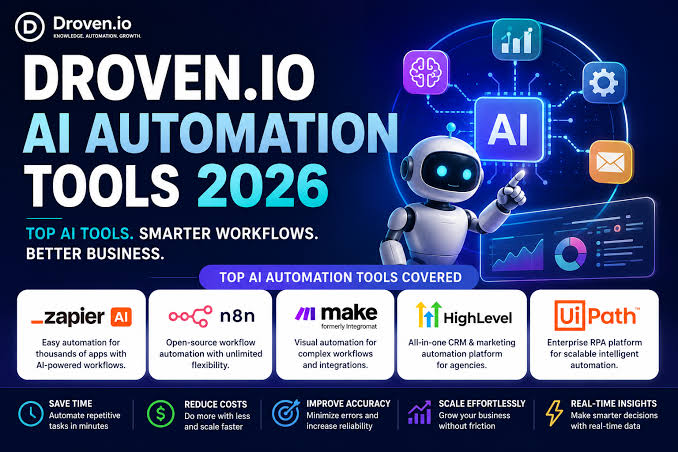
Snippet Answer: Droven.io covers AI automation tools including n8n, Make (formerly Integromat), Zapier AI, GoHighLevel, UiPath, and custom LLM-powered pipelines built on models like GPT-4o and Claude. It provides vendor-neutral analysis to help businesses select the right automation stack.
Is Droven.io worth using?
Snippet Answer: Yes, for research and pre-purchase education. Droven.io is most valuable during the evaluation phase before a business selects and implements an AI automation tool. It does not replace hands-on testing but provides useful context that most vendor websites deliberately omit.
Key Takeaways Drove.io Review
- Droven.io is a free editorial knowledge platform, not an AI software tool or SaaS product.
- Its primary value is in helping businesses understand the AI automation landscape before spending on tools.
- The automation tools it covers n8n, Make, Zapier AI, UiPath, GoHighLevel solve fundamentally different problems and suit different team profiles.
- Tool selection is not the hardest part of automation. Implementation quality, data readiness, and process clarity matter more.
- For European and DACH businesses, data residency and GDPR compliance heavily influence which tools are viable n8n’s self-hosted model remains the strongest option here.
- Most SMBs reach positive ROI from AI automation within 60–90 days when they start with a clear, scoped use case rather than trying to automate everything at once.
- Droven.io is a useful starting point but should be paired with hands-on trials and specialist evaluation before any significant investment.
Droven.io AI Review The automation tools
Search for “Droven.io AI automation tools” and you will find a crowded results page articles claiming Droven.io is a cloud-based intelligent automation platform, a smart workflow engine, or some kind of AI-powered business operating system.
Most of those descriptions are wrong.
Before you spend an afternoon reading comparisons built on a false premise, this article sets the record straight. We will tell you exactly what Droven.io is, what it covers, which AI automation tools actually sit inside the ecosystem it documents, and how to make a genuinely informed decision about which tools might serve your business.
If you arrived here wanting honest context rather than a sales pitch, you are in the right place.
What Is Droven.io? Setting the Record Straight

Droven.io is a free, editorially independent AI and technology knowledge platform. It publishes structured educational content on artificial intelligence, machine learning, automation, cloud computing, and cybersecurity. It does not sell software. It does not operate as an affiliate marketplace. It does not vendor-lock readers into any particular tool.
The clearest way to understand it:Droven.io Review The AI Automation tools is what you read before you buy. It is the research phase, not the implementation phase.
The name carries deliberate intent. “Droven.io AI Automation Tools” draws from an older regional English usage an informal past participle of “drive” chosen to reflect the platform’s positioning as driven by curiosity and a genuine commitment to making technology knowledge accessible without a sales agenda attached.
That positioning matters considerably in 2026. The AI automation space is crowded with sponsored reviews, affiliate-driven rankings, and vendor-funded comparison content. When a business owner searches for guidance on the right automation stack, the majority of results they encounter are structurally motivated to push one product over another. Droven.io sits outside that model. It acknowledges AI limitations rather than exclusively promoting AI potential a structural choice that distinguishes it from most of what ranks around it.
What the platform covers includes: workflow automation concepts and tool analysis, no-code and low-code automation principles, AI agent architectures, machine learning applications across industries, cloud infrastructure, cybersecurity frameworks, and US technology market trends.
Droven.io Review
What it does not cover: it is not a breaking-news site, a technical research journal, or a product launch directory. Its strongest angle is accessibility helping readers understand technology categories without forcing them into sales conversations.
The target audience reflects this. Business owners who need a realistic picture of what AI can and cannot do. Developers and IT managers who want to track tooling trends without wading through academic papers. Marketing and operations teams being handed automation tools they want to actually understand. Students and career changers entering AI, data science, or automation roles.
One observation worth noting from time spent with the platform: Droven.io says something many vendor-adjacent publications avoid. Specifically: AI does not fix broken processes. It amplifies them. If your internal operations are chaotic, automating them makes the chaos happen faster. That honest framing is genuinely useful, and it shapes the rest of this article.
Droven.io AI Automation in USA
The AI Automation Tool Landscape Droven.io Review Covers
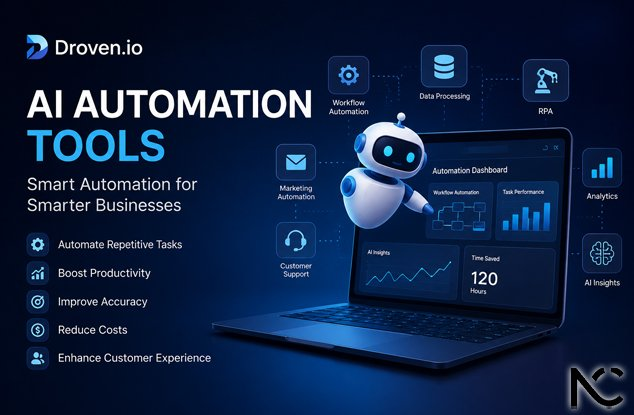
When people search for “Droven.io AI automation tools,” they are typically looking for one of two things: an explanation of what Droven.io is, or a guide to the specific automation platforms it documents and analyzes. This section addresses the second question directly.
The platform covers four primary categories of AI automation tooling.
Workflow Automation Platforms connect disparate systems and trigger automated action sequences based on defined logic or AI-detected conditions. The leading tools in this space include n8n, Make (formerly Integromat), and Zapier AI. These are the tools most SMBs and mid-market teams encounter first when exploring automation.
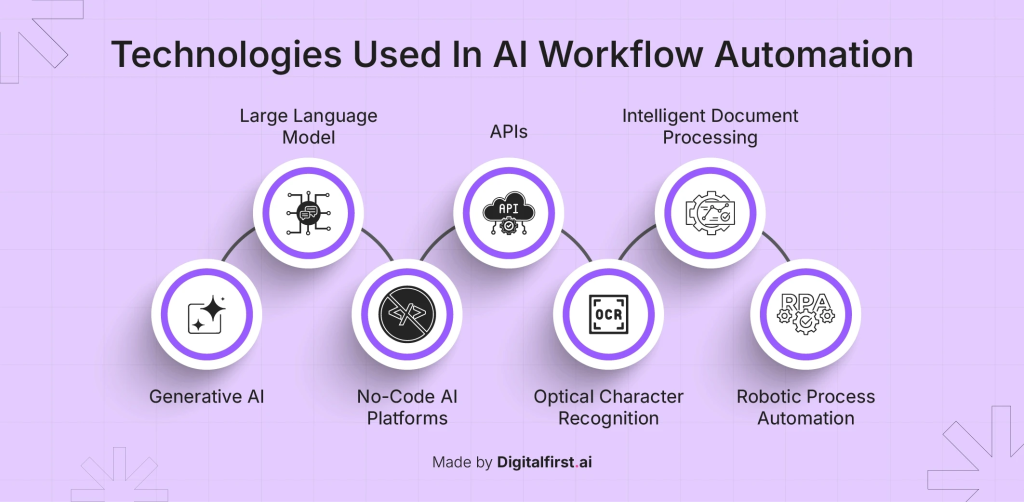
Robotic Process Automation (RPA) automates desktop and screen-level interactions the ability to mimic human actions inside software that has no API. UiPath and Automation Anywhere lead this category. RPA is particularly relevant for organizations running legacy systems that were never designed to integrate with modern cloud platforms.
Conversational AI and LLM-Powered Systems cover the deployment of large language model-based chatbots and voice agents for customer interactions, lead qualification, and support automation. These systems are typically built on APIs from OpenAI, Anthropic, or Google and integrated into broader workflow stacks.
CRM and Sales Automation centers on platforms like GoHighLevel, which bundles CRM, pipeline management, lead qualification, appointment booking, and outreach automation into a single system designed for service businesses and marketing agencies.
Understanding which category applies to your use case is the first decision that matters. A business trying to connect Shopify to their email marketing platform needs a different solution than a healthcare organization trying to automate appointment syncing from a legacy desktop system.
Core Automation Categories Explained
Not all automation is the same, and conflating the categories leads to expensive mistakes. Here is how they differ in practice.
Rule-Based Automation vs. AI Automation
Traditional automation executes predefined rules. If X happens, do Y. Always X, always Y. This works well when inputs are clean, processes are predictable, and nothing unexpected occurs. Zapier and Make operate primarily in this space, though both have added AI layers.
AI automation introduces judgment. Instead of following a rigid flowchart, AI-powered systems can interpret context, handle exceptions, make decisions under ambiguity, and adapt when inputs change. This is where LLM-powered agents enter the picture systems that reason about objectives rather than just executing steps.
The practical distinction: if your workflow involves exceptions, edge cases, or situations that require interpretation, rule-based automation will break regularly and require constant maintenance. AI automation handles those cases better, but it introduces its own complexity around prompt design, output validation, and hallucination risk.
No-Code vs. Low-Code vs. Developer-Native
Zapier is designed for non-technical users. Its visual builder, 9,000+ pre-built integrations, and AI copilot that generates workflows from natural language descriptions make it the fastest path to automation for teams without engineering resources.
Make sits in the middle. Its visual interface is more capable than Zapier’s but involves more setup. Enterprise users appreciate its observability and agent orchestration features, but the perceived ease of use can create overconfidence in users who have not fully grasped the underlying logic.
n8n is developer-native. It is open-source (under a fair-code model with commercial use restrictions), self-hostable, and supports custom JavaScript nodes, direct API connections to any service, and deep integration with LLM APIs. It is the strongest option for teams that want full control over where their data lives and how their automation logic runs. The tradeoff: it requires someone with technical understanding to set up and maintain.
UiPath sits in its own category built for RPA and legacy system automation. It is powerful for organizations whose workflows live inside desktop applications or proprietary systems that resist API integration, but it comes with enterprise-level complexity and cost.
AI Automation Workflow Examples
Abstract explanations only go so far. Here is how these tools actually function in real business contexts.
E-commerce Order Processing (n8n or Make) A new order triggers from Shopify. n8n captures the webhook, checks inventory levels in a warehouse management system via API, generates a packing slip, routes the order to the relevant fulfillment team via Slack, and creates a customer service ticket in Zendesk all without human intervention. If inventory is below a threshold, a separate branch triggers a reorder email to the supplier. The entire sequence runs in under three seconds.
Lead Qualification and Follow-Up (GoHighLevel + LLM) A website visitor submits a contact form. GoHighLevel triggers an automated SMS within 90 seconds. An AI agent built on GPT-4o engages the lead in conversation, qualifies their budget and timeline, and books a discovery call directly into the sales team’s calendar. The CRM record is updated with qualification notes. The sales team opens a fully briefed prospect profile without anyone manually touching the lead.
Customer Support Automation (Zapier AI + Claude API) A support ticket arrives via email. Zapier routes it through an AI classification step built on Anthropic’s Claude API, which categorizes the issue, checks the knowledge base for a match, and drafts a response. If confidence is above a set threshold, the response is sent automatically. Below threshold, the ticket is escalated to a human with the draft and relevant context pre-loaded. First-response time drops from hours to seconds.
Legacy System Integration (UiPath) A hospital scheduler needs appointment data synchronized between a proprietary desktop booking system and a cloud-based CRM. The desktop system has no API. UiPath bots mimic the human workflow navigating screens, extracting data, and pushing it to the CRM via its API. Manual data entry errors, which were averaging several per shift, are eliminated entirely.
These examples illustrate why tool selection cannot be made in the abstract. The right tool depends entirely on where your data lives, how your systems are built, and whether your team has technical resources to configure and maintain the automation layer.
Who Actually Benefits from Droven.io’s Coverage
The platform’s editorial content serves specific audiences better than others.
Business owners in the evaluation phase benefit most. If you are trying to understand what AI automation actually does before booking a vendor demo, Droven.io provides context that is structurally difficult to get from the vendors themselves.
Operations and marketing managers being handed AI tools they did not choose and need to understand will find the plain-language explanations genuinely useful. The platform does not assume technical background.
Developers and IT managers tracking the evolving landscape of automation tooling will find the category-level analysis worth reading, though they will need more technical depth from sources like the n8n official documentation or Zapier’s developer resources for implementation guidance.
Small and medium business owners get honest context on what these tools realistically cost, how long implementation takes, and what operational readiness is required before deployment makes sense.
What Droven.io does not do particularly well: it is not a hands-on testing environment. It cannot substitute for a free trial, a proof-of-concept deployment, or a conversation with an implementation specialist. The gap between understanding what a tool does and successfully deploying it inside your operations is significant, and that gap is where most automation projects stall.
Pricing of the Tools Droven.io Reviews
Understanding how automation tool pricing actually works is one area where many platforms fall short. Here is what current pricing looks like across the major tools in this space.
Zapier separates pricing across its product lines. The AI Orchestration free tier includes 100 tasks per month. The Professional plan starts at $19.99/month (billed annually) and covers 750 tasks per month with multi-step Zaps and webhook support. Enterprise plans require direct contact. Critically, Zapier’s task-based pricing model scales poorly at high volume teams automating thousands of processes per month will find costs escalate quickly.
n8n offers a self-hosted Community edition at no cost. The Cloud plan starts at approximately $20/month. For teams that can manage their own infrastructure, self-hosted n8n eliminates per-execution costs entirely, which can represent substantial savings at scale. One analysis found a workflow costing over $7,000 annually on task-based pricing platforms running for approximately $320 on self-hosted n8n.
Make (formerly Integromat) uses operation-based pricing, which is more predictable for moderate-volume workflows than task-based models. The Core plan starts at around $9/month. The Enterprise tier requires a custom quote.
UiPath lists a Basic plan starting at $25/month for individuals. Standard and enterprise tiers require sales engagement and can reach six-figure annual licensing costs for large deployments, before accounting for dedicated development and maintenance overhead.
GoHighLevel is priced as a platform rather than a per-task model, starting at $97/month. For service businesses and marketing agencies, it replaces multiple point solutions, which can make the per-seat cost competitive when calculated against the alternatives.
For most small to mid-sized businesses, a functional AI automation setup typically costs between $10 and $100 per month at the platform level. The hidden costs implementation time, integration development, and ongoing maintenance consistently exceed the subscription cost for teams that underestimate the work involved.
Security and Data Privacy Considerations
Security is where tool selection decisions become genuinely consequential, particularly for businesses operating in regulated industries or under GDPR requirements.
Cloud-native platforms (Zapier, Make) route data through vendor-managed infrastructure. Zapier processes data through US-based AWS servers. For businesses where data must remain within EU or DACH jurisdictions, this is a significant limitation. Zapier has no confirmed EU data residency option and no self-hosting capability.
n8n is the strongest option for data sovereignty. Its self-hosted model gives organizations complete control over data flows. The Cloud version offers hosting on Azure Frankfurt, which satisfies many EU data residency requirements. For German businesses with strict GDPR requirements, n8n’s Berlin headquarters and self-hosting option make it the default-first choice.
UiPath leads the enterprise field in AI governance and compliance readiness, particularly relevant as the EU AI Act continues enforcement through 2025–2026. Its AI Trust Layer includes PII masking, model selection controls, and comprehensive audit trails. For organizations in healthcare, finance, or legal sectors where explainability and audit requirements are non-negotiable, UiPath’s governance architecture justifies the premium cost.
A note on open-source platforms: in February 2026, critical vulnerabilities in n8n were publicly disclosed that could enable sandbox escape. Self-hosted deployments require teams to apply security patches promptly and maintain infrastructure hygiene. Open-source does not mean secure by default.
For any automation stack handling customer data, personally identifiable information, or financial records, data classification, encryption in transit and at rest, access control, and audit logging are non-negotiable baseline requirements regardless of which platform you select.
Droven.io AI Automation Tools vs. Other AI Information Sources
Understanding where Droven.io sits relative to other content platforms helps you use it appropriately.
vs. Coursera/Udemy: Course platforms deliver structured curricula leading to credentials. Droven.io is not a course environment. It does not offer certificates, structured learning paths, or assessments. It is a reference resource, not a training program.
vs. ChatGPT: ChatGPT is an AI tool you interact with to generate outputs. Droven.io is a content platform you read for context. They serve fundamentally different purposes and are not competitors.
vs. MIT Technology Review / Stanford AI Index: Academic and institutional publications offer rigorous research and primary data. Droven.io translates that research into plain language for a business audience. It references the Stanford AI Index and similar sources rather than producing original research.
vs. Affiliate review sites: The structural difference matters. A platform that does not derive revenue from product recommendations has no built-in incentive to skew coverage toward higher-commission tools. Droven.io’s advertiser-supported model where editorial content is not steered by vendor payments puts it in a different category from the majority of AI tool review content online.
vs. Vendor documentation: Official documentation like Zapier’s resource library or n8n’s blog provides authoritative technical depth for tools you have already selected. Droven.io is most useful before that selection, not after.
The Tools Themselves: Head-to-Head Comparisons
For users who have read the Droven.io context and are now ready to evaluate specific platforms, here is how the primary tools compare across the dimensions that matter most.
Zapier vs. n8n
Zapier wins on accessibility, speed of setup, and breadth of pre-built integrations (9,000+). For non-technical teams automating straightforward connections between popular SaaS apps, it remains the most practical starting point. Its AI copilot generates working automations from natural language descriptions, which meaningfully lowers the barrier to entry.
n8n wins on flexibility, data control, and cost at scale. Self-hosted deployments eliminate per-execution pricing. Custom JavaScript nodes and direct API access give technically capable teams control that Zapier’s architecture cannot match. For organizations building complex, high-volume automation systems or those with data residency requirements n8n is consistently the stronger choice.
The decision framework is relatively straightforward: no engineering resources and moderate automation needs point toward Zapier; developer-led teams with custom requirements and volume concerns point toward n8n. Many mature automation stacks use both.
Make vs. Zapier
Make and Zapier serve overlapping audiences but differ in depth. Make’s visual builder handles more complex data routing and provides better observability for enterprise deployments. Its enterprise “Grid” feature for AI orchestration gives operations teams a higher-level view of agents, workflows, and apps in production. Zapier is faster to set up for simple use cases; Make scales better for sophisticated, multi-branch logic.
UiPath vs. Everything Else
UiPath occupies a distinct category. When workflows live inside desktop applications, legacy systems, or software with no API surface, UiPath’s RPA capabilities have no direct equivalent among modern iPaaS platforms. The comparison with Zapier or n8n is somewhat moot they solve different problems. Where UiPath does compete is at the enterprise AI automation layer, where its governance and compliance tooling gives it an advantage over platforms that have added AI capabilities as a feature rather than building around them.
Limitations What Droven.io Does Not Do
Intellectual honesty requires acknowledging what the platform does not offer.
Droven.io does not provide hands-on software testing. Its analysis is editorially produced, not generated from systematic benchmarking or controlled trials. Readers should supplement platform research with free trials, proof-of-concept deployments, and input from practitioners who have implemented the tools in production environments similar to their own.
The platform’s content depth varies across topics. Its AI automation coverage is substantially stronger than, for example, its quantum computing content. For highly specialized technical questions, practitioners and official documentation remain the more reliable source.
Content currency is a legitimate concern in a space that moves as fast as AI tooling. A platform that publishes evergreen educational content may lag on recent product updates, pricing changes, or newly disclosed security vulnerabilities. Droven.io’s approach prioritizes durable explanations over timely news, which is the right trade-off for most readers but requires supplementing with current sources for time-sensitive decisions.
Implementation Challenges the Platform Rarely Mentions
Having reviewed automation platforms and observed real-world deployments, several recurring failure patterns are worth naming explicitly.
The clean data assumption. Every automation tutorial assumes your data is clean, consistently formatted, and reliably structured. In practice, it rarely is. Lead data comes in with inconsistent phone number formats, incomplete addresses, and duplicate records. Before automating anything involving customer data, data normalization is the unglamorous first step that most implementation guides skip.
The edge case problem. Rule-based automations work perfectly until they encounter a situation the original designer did not anticipate. The 20% of cases that fall outside the defined workflow still require human handling, and that handling often takes longer than the manual process it replaced because the team has deprioritized the manual process and no longer has a smooth workflow for exceptions.
Team adoption resistance. Automation changes how people work, and people resist changes to how they work. Marketing automation that reroutes lead assignments changes who gets commission credit. Customer service automation that deflects tickets changes headcount needs. Technical implementation is often the easier part; organizational change management is where projects stall.
The maintenance burden. Every automation that touches an external service depends on that service’s API remaining stable. API changes, authentication updates, and service deprecations break automations sometimes silently. Production automation stacks require ongoing monitoring, alerting, and maintenance. Teams that build automations and then forget them will accumulate broken workflows at a faster rate than they realize.
Vendor lock-in at the workflow level. Migrating complex automations from one platform to another is genuinely difficult. Zapier Zaps do not export to n8n natively. GoHighLevel workflows cannot be lifted into HubSpot without reconstruction. Platform selection deserves more permanence-of-decision weight than most teams give it.
Best Use Cases by Industry
AI automation tools deliver uneven value depending on industry context. Here is where the ROI evidence is strongest.
Marketing and Lead Generation: Email sequence automation, lead scoring, CRM enrichment, and follow-up cadence management are the highest-value automation targets for marketing teams. The combination of GoHighLevel or HubSpot with an AI-powered lead qualification layer consistently reduces time-to-first-contact and improves conversion rates on inbound leads.
E-commerce and Retail: Order processing, inventory management, post-purchase customer communications, and return handling are well-established automation wins. Make and Shopify-native tools handle most of these use cases without requiring custom development.
Healthcare Administration: Appointment scheduling, patient intake form processing, and insurance eligibility verification involve high volume, low variation, and significant cost consequences for errors. UiPath’s RPA capabilities are well-matched for healthcare organizations running legacy scheduling systems. Data privacy requirements HIPAA in the US, GDPR in Europe make self-hosted or on-premise deployments essential.
Financial Services: Invoice processing, expense categorization, compliance reporting, and fraud pattern detection are areas where AI automation is already delivering measurable operational cost reduction. The McKinsey Global Institute’s AI research has documented consistent productivity gains in financial services automation deployments.
Customer Service: AI-powered ticket classification, response drafting, and knowledge base retrieval are mature use cases with well-documented ROI. The most important variable is not which tool you use it is the quality of your knowledge base and the clarity of your escalation logic.
Professional Services and Agencies: Proposal generation, project status reporting, client communication automation, and billing workflow management are high-value targets for consultancies, law firms, and creative agencies where staff time is the primary cost driver.
Expert Evaluation: Where Droven.io Sits in the Market
After examining the platform and the tools it covers, this is an honest editorial assessment.
Droven.io occupies a genuine and underserved position. In a content market dominated by vendor-funded comparison sites and affiliate-driven reviews, a platform committed to vendor-neutral explanation has real value. The content reads as written for comprehension rather than conversion, which is a structural rarity.
The practical limitation is that reading about automation is not the same as implementing it. The gap between understanding what a tool does and successfully deploying it inside your operations is significant. Droven.io bridges the knowledge gap. It does not bridge the execution gap.
The most useful way to use Droven.io is as a starting point in a broader research process: read the platform context, then request trials from the tools you shortlist, then speak to a specialist implementation partner or an experienced practitioner in your industry before committing budget. Implementation quality not tool selection is consistently the primary determinant of whether an automation project delivers ROI.
A finding supported by industry research: businesses using specialist deployment teams reach positive ROI measurably faster than those self-deploying, particularly for complex multi-system automation stacks. The Gartner research on automation adoption has documented that failed automation projects fail most often due to poor integration architecture and unclear use cases, not tool limitations.
That context the one Droven.io is best positioned to provide is genuinely valuable. Go in with realistic expectations.
The Future of AI Workflow Automation
The direction of the market is clear enough to make confident observations without overstating what is knowable.
The boundary between workflow automation and AI agent systems is dissolving. Gartner introduced the category “Business Orchestration and Automation Technologies” (BOAT) in late 2025, signaling that RPA, iPaaS, and workflow automation are converging into unified platforms. By 2027–2028, the distinctions between tools like n8n, UiPath, and Zapier will be less clear than they are today.
AI agents autonomous systems that plan multi-step tasks and adjust to new inputs without constant human oversight are moving from pilot deployments to production for enterprise customers. Google and Microsoft are already embedding agent-based systems into enterprise products. The implications for automation platform selection are significant: the platform that best orchestrates AI agents with existing automation infrastructure will dominate the next market cycle.
For businesses in Europe, the EU AI Act’s progressive enforcement through 2025–2026 is already influencing enterprise automation decisions. Platforms with robust AI governance, explainability, and audit capabilities UiPath is currently the strongest here will have a structural advantage in regulated industries.
The bottom line for 2026 and beyond: automation tool selection is already more complex than it was two years ago, and it will continue to grow more complex. Platforms like Droven.io that help businesses develop a clear understanding of the landscape before they commit are more useful now than they were when AI automation was simpler. Use them accordingly.
Droven.io Review 2026: Is It Worth Your Time?
If you’re searching for an honest Droven.io AI Automation Tools review, you’re probably wondering whether the platform is a real AI solution, a technology publication, or simply another website covering automation trends. In this Droven.io Review 2026, we’ll examine what the platform offers, who it is designed for, and whether it deserves your attention. Unlike many websites that focus only on features, this review also evaluates usability, content quality, and overall value to help you make an informed decision. Independent reviews generally describe Droven.io as an educational platform focused on AI, automation, cloud computing, and cybersecurity rather than a traditional SaaS application.
Why Droven.io AI Automation Tools Are Gaining Attention
The growing popularity of Droven.io AI Automation Tools comes from the increasing demand for trustworthy AI resources. Instead of selling a single automation product, Droven.io publishes guides, reviews, and educational content that help businesses understand artificial intelligence before adopting new technologies. Whether you’re a marketer, entrepreneur, developer, or student, Droven.io AI Automation Tools provide practical insights into automation workflows, machine learning, generative AI, and digital transformation. This educational approach is one reason many readers are discovering the platform in 2026.
Key Features of Droven.io AI Automation Tools
One of the biggest strengths of Droven.io AI Automation Tools is the variety of topics covered. Readers can explore detailed software reviews, automation strategies, cybersecurity guides, cloud computing resources, and AI tutorials in one place. Instead of promoting a single vendor, Droven.io AI Automation Tools compare different technologies and explain where each solution fits in real business environments. This makes the platform useful for beginners as well as professionals researching automation solutions before making purchasing decisions.
Droven.io Review 2026
After evaluating the platform, this Droven.io Review 2026 shows that Droven.io AI Automation Tools are best suited for users looking to learn about AI and automation rather than purchase an all-in-one software product. If your goal is to understand emerging technologies, compare AI solutions, or stay updated with automation trends, Droven.io AI Automation Tools offer valuable educational content. While the platform continues to expand its library, its clear writing style and practical approach make it a useful resource for anyone interested in artificial intelligence in 2026.
Best AI Music Generation Tools for 2026
FAQs
1. What is Droven.io AI Automation used for? Droven.io is used as a research and education resource for AI, automation, cloud computing, and cybersecurity topics. It helps business owners, developers, and operations professionals understand the AI automation landscape before selecting and implementing tools.
2. Is Droven.io free to access? Yes. Droven.io is free to access with no subscription, paywall, or mandatory registration. It operates as an advertiser-supported editorial publication.
3. What AI automation tools does Droven.io cover? The platform covers workflow automation tools including Zapier AI, n8n, Make, GoHighLevel, UiPath, and custom LLM-based systems built on models from OpenAI, Anthropic, and Google. It provides vendor-neutral analysis rather than product rankings paid for by vendors.
4. How does Droven.io compare to Zapier? They are fundamentally different things. Droven.io is a knowledge platform that explains and analyzes tools. Zapier is an automation platform that connects apps and executes workflows. They serve completely different purposes and are not competitors.
5. Can small businesses benefit from the tools Droven.io reviews? Yes. Many of the tools Droven.io covers particularly Zapier, Make, and GoHighLevel are designed for SMB adoption with accessible pricing and no-code interfaces. Most small businesses can build their first functional automation workflow within days, not weeks.
6. Is Droven.io affiliated with any software vendors? Based on available public information, Droven.io operates as an editorially independent platform and does not appear to derive revenue from vendor-paid rankings or affiliate commissions on the tools it covers. It operates with advertising support, which is structurally different from affiliate-driven review content.
7. What industries benefit most from AI automation? Marketing and lead generation, e-commerce, healthcare administration, financial services, and customer service have the strongest documented ROI from AI automation deployments. Professional services firms and agencies are also high-value targets due to the labor cost of manual processes.
8. What is the difference between workflow automation and RPA? Workflow automation connects cloud applications and automates data flows between them using APIs. RPA (Robotic Process Automation) automates desktop and screen-level interactions, including legacy applications that have no API. Zapier and Make lead workflow automation; UiPath and Automation Anywhere lead RPA. Many enterprise organizations use both.
9. How do I choose between n8n and Zapier? If your team has no engineering resources and needs to connect popular SaaS apps quickly, start with Zapier. If you have developers, need custom logic, work with high volumes, or require data to stay on your own infrastructure, n8n is the stronger choice. The decision often comes down to technical capability and data sovereignty requirements.
10. What are the security risks of AI automation platforms? Key risks include data passing through vendor-managed infrastructure (relevant for GDPR and HIPAA compliance), API authentication vulnerabilities, open-source platform vulnerabilities that require patch management (as seen with n8n in early 2026), and AI output errors in automated pipelines with insufficient human review. Self-hosted deployments mitigate data residency risks but introduce infrastructure management obligations.
Final Verdict
Droven.io is what it says it is: an independent knowledge platform that helps people understand AI and automation before they spend money on either. In a content environment where most AI tool reviews are structurally incentivized to push one product over another, that positioning has genuine value.
The platform is best used as a starting point. It provides context that vendor websites deliberately withhold particularly around failure modes, implementation complexity, and realistic timelines and that context is worth having before you enter a sales conversation.
It does not replace hands-on testing, specialist advice, or the hard work of scoping your actual use case before touching a tool. No content platform does. The businesses that get the most from AI automation are the ones that use resources like Droven.io to build conceptual clarity, then bring that clarity into the implementation process rather than expecting the tools to figure it out for them.
For the tools themselves: the right choice depends on your technical resources, your data requirements, your volume expectations, and your regulatory context. There is no universally correct answer to “which AI automation tool should I use” and any source claiming there is, is probably selling something.
Article written for AIToolsChecked. All tool references and market data are drawn from publicly available sources. No affiliate relationships or vendor payments influenced the editorial content of this article.